Q: Can you use a hair transplant to treat radiation-induced permanent hair loss in pediatric patients?
A: Yes, but there are a number of things to consider:
- As in adults, if the hair loss from radiation is extensive, or involves the permanent zone of the scalp, there would not be enough donor hair to make the procedure worthwhile.
- Depending on the nature of the scarring, it may not take grafts well and always will require multiple procedures to achieve adequate density.
- Hair transplant procedures (both FUT and FUE) leave scarring, so future treatments for tumor recurrences that cause hair loss (radiation or chemo) may expose these scars and be an additional cosmetic problem.
- There is a concern that the younger patient may eventually develop androgenetic alopecia and this would be a problem if extensive and occurring early. Family history, of course, is important, but there is no way to tell with certainty the prognosis of AGA in a young person.
- For those that might develop AGA, finasteride is not indicated in males under 18 and there is no way to tell in advance if the person can tolerate this medication.
- The hair transplant procedure is long, so local rather than general anesthesia is used. That said, 12 y/o is generally the minimum age that a patient can tolerate the procedure and a 12 y/o needs to be mature and motivated. Certainly, waiting until the patient is older makes it easier surgically.
Q: My hair is starting to thin in the front, but it is not yet bald. I have been going back and forth about whether to get a hair transplant or use Propecia. I’m not sure what my first step should be. What do you think? — N.K. ~ Pleasantville, N.Y.
A: In general, patients who are thinning, but not actually bald, should begin with combined medical therapy (finasteride and minoxidil) for at least a year prior to considering surgery. In many cases, with this regiment, surgery can be postponed or even avoided completely. Unfortunately, some patients cannot tolerate finasteride or choose not to take it due to concern about potential side effects. Minoxidil, although useful, does not significantly alter the long-term course of hair loss when used alone.
Q: I have read several articles on the internet which suggest that resistance training can accelerate male pattern baldness. Is there any truth in this? –B.F., Altherton, CA
A: Anything that raises androgen levels in your body can potentially accelerate hair loss. That said, I suggest that you should exercise as you normally would. As long as you don’t take drugs to enhance your workout, the effects should be minimal.
Q: I have been using an increased dosage of Propecia now for around 8 months and Rogaine for about 6 months. I know that shedding can be expected for the first 3-6 months, but I believe I am now beyond that timeframe. Have you seen cases in which these products merely exacerbate hair loss without the expected regrowth? — N.E., Travilah, Maryland
A: It is a bit long to still see shedding, but from my experience, either the medications are working (and you are still in the shedding phase) or you are not responding to them. I have not seen minoxidil or finasteride worsen hair loss. My advice would be to continue the same course for at least a year before re-evaluating their use.
Q: How common is hair loss in adult men and women? — N.F., Bronxville, NY
A: The incidence of androgenetic alopecia (common baldness) is quite high for both men and women. By age 50, 50% of men and 30% of women are affected. By age 70, that increases to 80% of men and 60% of women. Fortunately, in spite of significant thinning, women often preserve their hairline and have a diffuse pattern, so their hair loss can be camouflaged for many years.
Q: What is Lichen planopilaris? — G.S., Pleasantville, NY
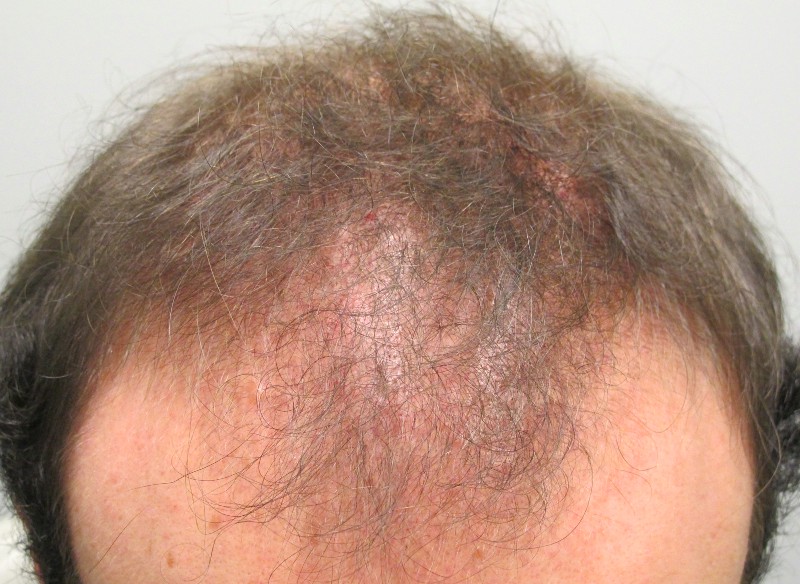 LPP in Male Pattern Alopecia
A: Lichen planopilaris (LPP) is a distinct variant of cicatricial (scarring) alopecia, a group of uncommon disorders which destroy the hair follicles and replace them with scar tissue. LPP is considered to have an autoimmune cause. In this condition, the body’s immune system attacks the hair follicles causing scarring and permanent hair loss. Clinically, LPP is characterized by the increased spacing of full thickness terminal hairs (due to follicular destruction) with associated redness around the follicles, scaling and areas of scarred scalp. In contrast, in androgenetic alopecia (AGA) or common baldness, one sees smaller, finer hairs (miniaturization) and non-inflamed, non-scarred scalp. Complicating the picture is that LPP and AGA can occur at the same time – particularly since the latter condition (common baldness) is so prevalent in the population (see photo). And LPP can involve the frontal area of the scalp, mimicking the pattern of common genetic hair loss. Interestingly, the condition is more common in women than in men.
For those considering a hair transplant, ruling out a diagnosis of LPP is particularly important as transplanted hair will often be rejected in patients with LPP. In common baldness, the disease resides in the follicles (i.e., a genetic sensitivity of the follicles to DHT). Since the donor hair follicles remain healthy, even when transplanted to a new location, we call common baldness donor dominant. It is the reason why hair transplantation works in persons with common baldness. In contrast, LPP is a recipient dominant condition. This means that the problem is in the recipient area skin, so if healthy hair is transplanted into an area affected by LPP the hair may be lost.
Because it is so important to rule out suspected LPP when considering a hair transplant and because it is often hard to make a definitive diagnosis on the physical exam alone, a scalp biopsy is often recommended when the diagnosis of LPP is being considered by your doctor. A scalp biopsy is a simple five minute office procedure, performed under local anesthesia. Generally one suture is used for the biopsy site and it heals with a barely detectable mark. It takes about a week to get the results. The biopsy can usually give the doctor a definitive answer on the presence or absence of LPP and guide further therapy. If the biopsy is negative, a hair transplant may be considered. If the biopsy shows lichen planopilaris, then medical therapy would be indicated.
Q: What is the Origin of the Term DUPA? — Z.Z., Darien, CT
A: The terms DPA and DUPA were first described by O’tar Norwood in his seminal 1975 publication: Male Pattern Baldness: Classification and Incidence. ((Norwood OT. Male pattern baldness: classification and incidence. So. Med. J 1975;68:1359-1365.  Download)) In the paper, Dr. Norwood defined the two terms as:
Diffuse, Unpatterned Alopecia (DUPA). In this type there is a general decrease in the density of hair without any definite pattern, although it is usually more marked over the top and front. This type is common in women.
Diffuse, Patterned Alopecia (DPA). The patterns in this type of hair loss are essentially the same as in more common male pattern baldness, but the areas involved do not become totally bald; the hair only decreases in density. This also occurs in women.
Dr. Norwood’s realization that all hair loss did NOT follow his own Norwood patterns was a great insight, as well as his observation that DUPA was a common pattern in women and uncommon in men. The terms went relatively unnoticed and were not seen again in the medical literature until Drs. Bernstein and Rassman wrote about them again when they were developing Follicular Unit Transplantation. ((Bernstein RM, Rassman WR: Follicular Transplantation: Patient Evaluation and Surgical Planning. Dermatol Surg 1997; 23: 771-84. Download)) The importance of identifying these conditions is that that DUPA (either in men or women) is a relative contra-indication for hair transplantation and, with densitometry, can be readily detected in individuals at a relatively young age. Patients with DPA can be transplanted as if they were early Norwood Class 6’s.
Q: I have been on finasteride for about 7 months. After my latest haircut I can see that my scalp is shiny. I read that is from sebum buildup and it can cause a layer that clogs the growth of hair. I was wondering if this is true and, if so, how can it be treated? — T.C., Philadelphia, PA
A: It is not true. Hair loss is caused by the miniaturizing effects of DHT on the hair follicle, not by blocked pores.
For more on this topic, view our pages on the causes of hair loss in men or the causes of hair loss in women.
Q: Why did you write another book on hair loss? — K.L., Greenville NY
A: Hair Loss and Replacement for Dummies is the first book that we have written that is specifically geared for the lay public. Besides hair restoration, it covers a wide range of topics including: the diagnosis and treatment of medical conditions that can cause hair loss, tips on hair care, information on hair systems, and a number of other topics not stressed in our other books.
Our prior books, The Patient’s Guide to Hair Restoration and The Guide to Hair Restoration focused on medical treatments and surgical hair restoration. Although very easy to understand, they are most helpful for someone that already has a basic understanding of hair loss or that had a consultation.
Q: Why do some people have a full head of hair into their seventies or eighties and others start to go bald in their late teens or early twenties? — E.Z., Darien, CT
A: The difference is genetic with the inheritance coming from either side of the family.
Although a person will have the genes his/her whole life, a gene’s expression (also called phenotype) can be quite variable. The factors that cause this variability are still unknown.
Read more about the Genetics of Hair Loss
Q: I have a quite a bit of hair on my chest, back and legs. Is that an indicator of future baldness? — S.C., Short Hills, NJ
A: Although bald people joke around that they wish the hair on their body (and ears) was on their head, body hair is not an early sign of baldness.
Read about the Causes of Hair Loss in Men
Q: I have read that in the evaluation of a patient for hair restoration surgery some doctors use a densitometer to measure miniaturization – the decrease in size of hair diameters. I read that miniaturization is a sign of genetic hair loss, but when there is miniaturization of greater than 20% in the donor area, a person may not be a good candidate for hair transplants. Is this correct and does 20% miniaturization mean that 20% of the population of terminal hairs have become fine vellus-like hairs or that there is a 20% decrease in the actual diameter of each of the terminal hairs? — B.A., New Albany, Ohio
A: Miniaturization is the decrease in hair shaft length and diameter that results from the action of DHT on healthy, full thickness terminal hairs. The hairs eventually become so small that they resemble the fine, vellus hair normally present in small numbers on the scalp and body. Miniaturized hairs have little cosmetic value. Eventually miniaturized hairs will totally disappear. Twenty percent miniaturization refers to the observation, under densitometry, that 20% of the hairs in an area show some degree of decreased diameter.
In the evaluation of candidates for hair transplantation, we use the 20% as a rough guide to include all hairs that are not full thickness terminal hairs. Of course we are most interested in the presence of intermediate diameter hairs — i.e. those whose diameters are somewhere between terminal and vellus and are clearly the result of DHT. I don’t know if one can tell the difference on densitometry between vellus hairs, fully miniaturized hairs and senile alopecia. The partially miniaturized population is most revealing.
Miniaturization in the recipient scalp (i.e. the balding areas on the front top and crown that we perform hair transplants into) is present in everyone with androgenetic hair loss. Miniaturization in the donor area, however, is less common (in men). It means that the donor area is not stable and will not be permanent. Men with more than 20% of the hair in the donor area showing miniaturization are generally not good candidates for hair transplant surgery.
Read about Miniaturization
Read about Candidacy for Hair Transplant Surgery
Q: I seem to be thinning, but I never shed hair as such in the shower. I cannot see my hair falling out. Can it be androgenetic hair loss? — R.C., Cambridge, MA
A: In androgenetic hair loss one rarely sees hair falling out in mass, but rather the thinning is due to the hair decreasing in diameter and length (a process called “miniaturization”).
Q: I am a Caucasian female that has experienced hair loss on the sides of my head from the height of the eyebrow to the ear due to traction. The hair loss has been present since my teen years. My job requires me to wear my hair up most of the time. Although I don’t wear it nearly as tight, I seem to continue to lose my hair in the front and on the top of my head. My hair also used to be very thick as a child and is now quite thin. I’m not sure if this is normal or something else is going on, but I am definitely interested in a hair transplant. — M.H., Larchmont, NY
A: It sounds like you are experiencing continued traction alopecia. Unless the underlying cause is corrected (the traction), you can expect to continue to lose your hair. People that have traction alopecia can have thinning even from mild pulling that might not be a problem for others. Once you stop the pulling, it can take up to two years for the hair to return, although there may be permanent hair loss.
Surgical hair restoration is the treatment of choice for permanent hair loss from traction. If you have significant thinning on the sides, you may not be a candidate for hair transplantation since in this procedure we often need to harvest hair from the permanent area in the sides of the scalp as well as the back.
An additional problem (that you allude to) is that you may have underlying female pattern hair loss. This would further complicate the surgical treatment.
A careful examination (including densitometry) can sort these problems out and allow for more specific recommendations.
Q: I am 22 and losing my hair all across the top of my head. How can I thicken my hair to its level a few years previously? — I.L., Kentfield, CA
A: If medication, such as finasteride, is successful it can thicken hair by increasing the diameter of the existing hair shafts. Although the cosmetic benefits can be dramatic in a person with significant hair loss, a hair transplant can not restore hair to its original density, since it only moves the existing hair around and does create new hair.
When hair cloning technology is available, this will change as a person’s donor supply will be increased.
Q: My hair loss resembles the grade I female hair loss scale, but none of the male hair loss patterns. It has been relatively stable for the past five years and only recently has it begun to progress further. I began both Propecia and Rogaine two months ago, but the hair loss still continues at the same pace. I’m really worried. Does a hair transplant work in such a diffuse hair loss? — D.D., Park Slope, Brooklyn
A: If your hair loss is diffuse only on top, then a hair transplant will be effective. This condition is called Diffuse Patterned Alopecia or DPA.
If the diffuse pattern of hair loss affects the back and sides as well, then surgical hair restoration should be avoided. In this case (called Diffuse Unpatterned Alopecia or DUPA) the donor area is not permanent and the transplanted hair will continue to thin over time.
Q: I underwent hair transplant surgery several years ago and was pleased with the results. However, over the last 2-3 years I’ve lost hair in the donor area with subsequent loss of hair in the transplanted area. Is this type of hair loss especially difficult to treat? What accounts for hair loss from the back of the head that is typically considered “permanent”? — F.D., Laude, Missouri
A: Less than 5% of patients have unstable donor areas, i.e. where the back and sides thin along with the front and top. We call this condition Diffuse Unpatterned Alopecia or DUPA. It is best to identify this condition before hair transplant surgery is contemplated as people with DUPA are not good candidates for hair transplantation. The diagnosis is made using densitometry by noting high degrees of miniaturized hair in the donor area.
At this point, I would use medications such as finasteride. I would not do further hair restoration surgery.
Q: I am a 36 year old female who has been diagnosed with Chronic Telogen Effluvium. Although I do not have any bald spots yet my hair is much thinner on both of my temples as well as in the back of my head. Is a hair transplant an option for me or am I just going to shed the new hair as I am shedding my current hair? — R.K., Providence, R.I.
A: Since Chronic Telogen Effluvium is a generalized condition, it is not amenable to correction by a hair transplant. The reason is that there is no stable area to take donor hair from. Chronic TE is generally self-limited, so try to be patient.
Q: Can stress accelerate hair loss? I am 25 and there is balding on my dad’s side of the family. I never had any thinning or hair loss till this year. I guess you can say I’ve been under a lot of stress. When I did notice shortly after my 25th birthday I started stressing even more, which led to more hair loss. It is thinner up front and it is thin on top. I have heard of some hair docs mapping your head for miniaturization, do you do this too? — E.W., Miami, FL
A: Yes. The presence of miniaturization (decreased hair diameter) in the areas of thinning allows us to distinguish between hair loss due to heredity (i.e. androgenetic alopecia) — in which hair progressively decreases in diameter under the influence of DHT — and other causes. The degree of miniaturization can be assessed using a hand-held instrument called a densitometer.
The pattern of hair loss and the family history are also important in the diagnosis.
Stress more commonly produces telogen effluvium, a generalized shedding that is not associated with miniaturization and is often reversible without treatment.
Q: Over the past three months, my hair seems to be thinning more on one side. Is it common in male pattern hair loss for it to be more on one side? I had a lot of stress about three months ago and have heard that this could be the cause. Is this possible? Should I use Rogaine to treat it? — B.R., Landover, MD
A: Regardless of the cause, hair loss is usually not perfectly symmetric. This applies to male pattern hair loss as well.
In your case, it is important to distinguish between telogen effluvium (shedding that can be due to stress) and hereditary or common baldness. The three month interval from the stressful period to the onset of hair loss is characteristic telogen effluvium, but you may have androgenetic alopecia as an underlying problem.
The two conditions are differentiated by identifying club hairs in telogen effluvium and miniaturized hair in androgenetic alopecia. In addition, a hair pull will be positive in telogen effluvium (when a clump of hair is grasped with the fingers, more than five hairs pull out of the scalp at one time) and will be negative in common baldness. The hair loss diagnosis can be made by a dermatologist.
Hair cuts do not affect either condition.
Rogaine (Minoxidil) is only effective in androgenetic hair loss and only marginally so. Finasteride is the preferred treatment if your hair loss is genetic when it is early and a hair transplant may be indicated if the hair loss progresses.
Shedding from telogen effluvium is reversible and does not require specific treatment.
Q: I am 19 years old and seem to be thinning all over, including the sides. My father has all of his hair but my grandfather is totally bald. Should I have a hair transplant now or wait until I am older? — T.K., Garden City, NY
A: Most likely you have a type of androgenetic alopecia called Diffuse Unpatterned Alopecia (DUPA). In this hereditary condition, hair thins all over rather than just on the front, top and back as in the more common male pattern baldness. The fact that the back and sides of your scalp are thinning (the donor area) precludes you from being a candidate for surgery. The diagnosis can be made by observing a high degree of miniaturization (fine hair) in the donor area under a magnifier. This instrument is called a densitometer.
For further information, please read the article:
Bernstein RM, Rassman WR: Follicular Transplantation: Patient Evaluation and Surgical Planning, published in the journal Dermatologic Surgery in 1997. Specifically, read the last part of the article.
Q: I am 27 years old and have a Class 3 degree of hair loss. Should I do a hair transplant or consider non-surgical methods of hair restoration? — Y.B., Lake Forest Illinois
A: At age 27 with early hair loss, you should consider non-surgical options first.
Propecia is the most important medication, but you need to be on it for one year at the full dose of 1mg a day to assess its benefits.
If you have done this and other parameters are OK for a hair transplant, such as adequate donor hair density and scalp laxity and you have little evidence that you will become extensively bald (i.e. no donor miniaturization and no family history of extensive baldness), then hair transplantation can be considered.
Q: I’m currently 24 years old. Ever since turning 20, my hair on top began to thin little by little. I have noticeable thinning on the top part of my scalp and on my crown, but have no recession at the temples. My hairline looks amazingly young and hair on the donor areas seems quite thick. Am I in the early stages of male patterned baldness? I cannot place myself in the Norwood scale since my thinning doesn’t seem to follow the classic pattern. I just started on Propecia. Should I be considering a hair transplant? — B.R., Landover, MD
A: From the description, it sounds like you have typical Diffuse Patterned Hair Loss or Diffuse Patterned Alopecia (DPA). In this condition, the top of the scalp thins evenly, the donor area remains stable, and the hairline is preserved for a considerable period of time. Please see: Classification of Hair Loss in Men for more information.
Propecia would be the best treatment at the outset. When the hair loss becomes more significant, patients with DPA are generally good candidates for surgical hair restoration. It is important, however, that your donor area is checked for miniaturization to be sure that it is stable before a hair transplant is considered.
Q: I am twenty and think that I am starting to thin. I am also experiencing a slight tingling in my scalp. Are these related? — T.N., Philadelphia, PA
A: Most likely. Early androgenetic alopecia can be associated with a slight tingling or slight tenderness of the scalp.
You should see a dermatologist for evaluation and, if you have early male pattern baldness, consider starting finasteride (Propecia).
Browse Hair Restoration Answers by topic: