 Columbia University Medical Center has awarded Dr. Bernstein, Clinical Professor of Dermatology, a “Certificate of Appreciation” for sustained contributions to the academic programs of the Department of Dermatology, Columbia University. Please read below for the Bernstein Medical – Center for Hair Restoration press release and a transcript of an interview with Dr. Bernstein on receiving the honor:
Press Release:
New York, NY (PRWEB) October 2, 2008 — Columbia University Medical Center awarded their Certificate of Appreciation to Robert M. Bernstein, MD, founder of Bernstein Medical – Center for Hair Restoration for his sustained contributions to the academic programs of the Department of Dermatology at Columbia University.
Dr. Bernstein specializes in hair loss and hair transplant surgery. He was instrumental in developing the Follicular Unit Hair Transplant procedure, now considered the most advanced technique for surgical hair restoration. This procedure has revolutionized modern hair transplantation, with its unique ability to mimic natural hair growth patterns in the scalp.
In the past, multiple, small procedures were an inefficient way to restore a person’s hair. Using these new techniques, we now have the ability to transplant 3000 or more follicular units safely in one session.
“With respect to medical feasibility, follicular hair transplant surgery is significantly different from traditional grafting,” notes Dr. Bernstein. “In the past, multiple, small procedures were an inefficient way to restore a person’s hair. Using these new techniques, we now have the ability to transplant 3000 or more follicular units safely in one session.”
The complex nature and microscopic scale of the Follicular Unit Hair Transplantation procedure require superior surgical precision. Dr. Bernstein is well known for his surgical skill and talent; he has been named in New York Magazine’s “Best Doctors” list 9 years in a row.
In addition to his world-renowned skill in the field of hair replacement surgery, Dr. Bernstein is also acclaimed for the care that he provides for his patients. Dr. Bernstein and the rest of the staff at the Bernstein Medical Center for Hair Restoration aim to provide their patients with the best possible care and comfort during their hair transplant procedure. Their award winning website www.bernsteinmedical.com is recognized for providing outstanding health information.
Columbia University is one of the world’s most important centers of medical research and distinguished learning environment for undergraduates and graduate students in many scholarly and professional fields. The University recognizes the importance of its location in New York City and seeks to link its research and teaching to the vast resources of a great metropolis. It seeks to attract a diverse and international faculty and student body, to support research and teaching on global issues, and to create academic relationships with many countries. It expects all areas of the university to advance knowledge and learning at the highest level and to convey the products of its efforts to the world.
About Dr. Bernstein:
Dr. Bernstein is the most widely published author on the subject of Follicular Unit Hair Transplantation, with over fifty articles, editorial reviews, books and textbook chapters. His landmark scientific papers are considered to be seminal works in the field of hair transplant surgery. In addition to a busy surgical practice, Robert M. Bernstein, MD, is Clinical Professor of Dermatology at Columbia University in New York. He lectures both nationally and internationally on the diagnosis and treatment of hair loss and treats patients from all over the globe at his state-of-the-art surgical facility in mid-town Manhattan.
Interview:
Interviewer: I am here today with Dr. Robert M. Bernstein, founder of the Bernstein Medical – Center for Hair Restoration. Dr. Bernstein is the recipient of the “Platinum Follicle Award” the highest honor given by the International Society of Hair Restoration Surgery. He has been chosen as one of New York Magazine’s “Best Doctors in New York” for nine consecutive years. Good morning Dr. Bernstein.
Dr. Bernstein: Good morning.
Interviewer: Dr. Bernstein, I understand you have recently been awarded a Certificate of Appreciation from Columbia University in New York.
Dr. Bernstein: Yes, I have been teaching at Columbia for 25 years. I was very honored to receive it.
Interviewer: Could you tell us about it?
Dr. Bernstein: The certificate is for the contributions that I have made to the academic programs of the Department of Dermatology.
Interviewer: You specialize in hair replacement and hair transplant surgery, and you were instrumental in developing the Follicular Unit Hair Transplantation procedure. Why don’t you tell us a little bit about this procedure and how you came up with the idea?
Dr. Bernstein: Sure. The Follicular Unit Hair Transplantation procedure is based on the discovery that in humans, hair does not grow singly as one commonly thinks, but rather, in tiny bundles of one to four hairs. We call these bundles follicular units. While evaluating patients for surgery using an instrument called a densitometer we could easily visualize these naturally occurring groups. It just made sense to perform the entire transplant using these tiny follicular units, as it would allow us to most closely mimic nature. We found that it also would enable us to safely transplant thousands of grafts in a single session and, for the patient, to complete the hair restoration as quickly as possible.
Interviewer: Interesting. I understand you not only use your knowledge in practice, but you are the most widely published author on this subject.
Dr. Bernstein: It is through publishing in medical and scientific journals that we can best share our ideas with our colleagues and ultimately improve patient care.
Interviewer: Is there a website where listeners can find these papers and learn more about the procedure and other information about hair loss?
Dr. Bernstein: Yes. If they go to the Bernstein Medical – Center for Hair Restoration website they will find links to all of my medical publications. The site has my blog and a lot of other useful information for persons who are experiencing hair loss.
Interviewer: Well, again congratulations, it was good to have you on the program.
Dr. Bernstein: Thank you.
Posted by Robert M. Bernstein M.D. 



 New York, NY — Robert M. Bernstein, M.D., F.A.A.D., world-renowned pioneer of the hair transplant techniques,
  Dr. Bernstein’s
  Hair transplant surgeon Robert M. Bernstein M.D. was recently interviewed on the National Public Radio program The People’s Pharmacy. Invited to speak about hair loss, Dr. Bernstein offered insights about the causes of hereditary baldness and it’s solutions, including hair transplantation.
 Follicular Unit Forum is unique in that it affords visitors an opportunity to anonymously ask questions about the “ins and outs” of hair transplant surgery, of those who actually have had the state-of-the-art Follicular Unit Hair Transplant procedures.
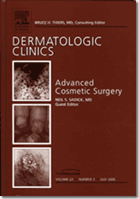 “Dermatologic Clinics” is a quarterly review with comprehensive, state-of-the-art information by experts in the field of dermatology. The industries most highly knowledgeable medical professionals provide current, practical information on the diagnosis and treatment of conditions affecting the skin. Each issue of Dermatologic Clinics focuses on a single topic. The July 2005 issue, entitled “Advanced Cosmetic Surgery”, published an article authored by Robert M. Bernstein M.D, and co-authored by William R. Rassman M.D. entitled “
 Surgery of the Skin: Procedural Dermatology; published in 2005 by Elsevier-Mosby and Edited by Robinson, Hanke, Sengelmann and Siegel; is monumental work that covers the entire spectrum of dermatologic surgical procedures. In the editor’s words, the goal of this 872 page textbook is:
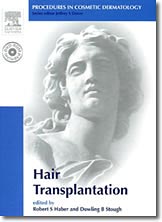 “Hair Transplantation” is one in a series of medical textbooks published by Elsevier Saunders. The textbook — part of a series entitled Procedures in Cosmetic Dermatology — is written by Robert S Haber and Dowling B. Stough and edited by Jeffrey S. Dover. “Hair Transplantation” offers a step-by-step, practical guide to performing cutaneous surgical procedures.
 Dr. Bernstein received the 2001 HairSite.com award for excellence in hair transplantation. Here is the statement they made in giving Dr. Bernstein the annual award: