New research published in the journal Developmental Cell has confirmed the importance of dermal sheath stem cells in maintaining the hair growth cycle. ((Rahmani W, et al. Hair Follicle Dermal Stem Cells Regenerate the Dermal Sheath, Repopulate the Dermal Papilla, and Modulate Hair Type. Dev Cell. 2014 Dec 8;31(5):543-58.)) These cells, located around the lower portion of growing follicles, form the basis of an experimental treatment, being developed by Replicel Life Sciences, Inc., to regenerate hair-producing follicles. If successful, the treatment will be a game-changer for the hair restoration industry.
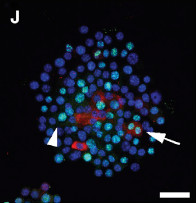 Colony of self-renewing dermal sheath cells
The study, published in December 2014, sought to confirm what had been indirect evidence of a type of stem cell residing in the dermal sheath (DS) that was said to replenish dermal papilla (DP) cells. The authors of the study suggest that they now have definitive evidence that new DP cells are derived from stem cells in the dermal sheath “cup” (DSC). This development clarifies the relationship between the DS and the DP and confirms that DSC cells play a critical role in hair follicle regeneration by repopulating the dermal papilla cells at the end of the telogen (resting) phase of the normal hair cycle.
Importance of the Dermal Sheath Cup Cells
The number of dermal papilla (DP) cells in a hair follicle has been found to be a determining factor as to when the anagen (growth) phase of the hair cycle is initiated. ((Chi W, Wu E, Morgan BA, et al. (2013). Dermal papilla cell number specifies hair size, shape and cycling and its reduction causes follicular decline. Development 140, 1676–1683.)) The gradual loss of DP cells over time results in a longer delay in the onset of the anagen phase; a longer telogen (resting) phase; and a hair follicle that shrivels and eventually disappears. This process, called miniaturization, plays out over multiple hair cycles and has been shown to be the primary contributor to androgenetic alopecia and eventual baldness. ((Randall VA. (2008). Androgens and hair growth. Dermatol. Ther. 21, 314–328.))
While dermal sheath cup (DSC) stem cells are known to be long-lived and self-renewing, it is not fully understood how they replicate or why the pool of DSC cells becomes depleted over time. We do know, however, that the gradual loss of DSC cells results in a failure to produce the necessary number of DP cells. And without enough DP cells to trigger the anagen phase, the follicle begins to miniaturize. It is clear that maintaining the population of DSC cells after each iteration of the hair cycle is very important in preserving and maintaining healthy and mature terminal hairs.
Replicel Reacts to the Study
The new data confirming the importance of the dermal sheath cup (DSC) cells was celebrated by researchers and executives at Replicel Life Sciences, Inc., who have been studying this issue for over a decade. Replicel is set to start phase II clinical trials of RCH-01, their proprietary treatment for androgenetic alopecia.
In the RCH-01 treatment, cloned DSC cells are injected into balding areas of the scalp where they are expected to reverse miniaturization and regenerate healthy, hair-producing follicles. Phase I trials of RCH-01, the results of which were published in 2012, showed that the treatment could produce promising results and that it was safe to administer. Six months after patients were treated with RCH-01, overall hair density increased by an average of 11.8% in ten patients out of 16. In two patients, overall hair density increased by more than 19%. There were no significant adverse safety events recorded. ((Lortkipanidze, N. Safety and Efficacy Study of Human Autologous Hair Follicle Cells to Treat Androgenetic Alopecia. In Clinicaltrials.gov. Retrieved July 26, 2012.)) Phase II clinical trials are set to begin in 2015, with data collection continuing for 39 months.
Through a 2013 agreement with Replicel, Japanese cosmetics giant Shiseido may introduce RCH-01 into the Asian market as early as 2018.
Image c/o Developmental Cell 31, 543–558, December 8, 2014 ª2014 Elsevier Inc.
Posted by
 LPP in Male Pattern Alopecia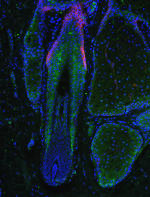

 Dr. Eric S. Schweiger, board-certified dermatologist, is quoted in a few recent articles on the effects of chemotherapy on hair, genetic testing for hair loss, and protecting a balding scalp from the sun.
 O, The Oprah Magazine featured
 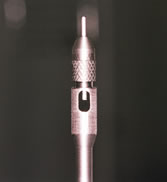 In a new article appearing on the cover of Hair Transplant Forum International, the official publication of The International Society of Hair Transplant Surgeons (ISHRS), pioneering hair transplant surgeon Robert M. Bernstein MD, along with his colleague Dr. William R. Rassman, recently revealed details about a “New Instrumentation for Three-Step Follicular Unit Extraction.”
 “Hair doesn’t grow singly it grows in naturally occurring groups of from one to four hairs. In follicular transplantation, we use these naturally occurring groups as the unit of the transplant,” he told CST.