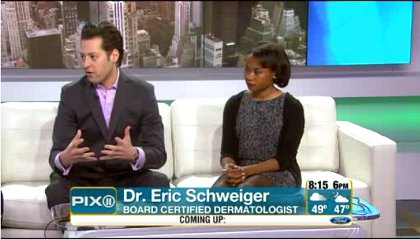
Dr. Schweiger lends his expertise on hair loss in women and cosmetic hair extensions in a segment on PIX 11 television. The interview with Dr. Steve Salvatore focused on the pitfalls of using some types of hair extensions, or using them improperly.
Hair extensions can result in undesirable bald patches caused by traction alopecia, which is hair loss due to a constant tugging on hair follicles.
Read the transcript of the interview below:
Dr. Steve: Dr. Schweiger, there are two types of hair extensions, tell me about those. The permanent and temporary type.
Dr. Schweiger: There are permanent and temporary. The temporary are just that. They are clip-on hair extensions, they’re meant to be used for weddings, special occasions, to test out a new hair style. And they are generally the safer of the hair extensions.
Then there are permanent hair extensions, and there are different types. One permanent type you actually sew into the hair.
Dr. Steve: So you sew it into the existing hair, not the scalp, but the existing hair.
Dr. Schweiger: Exactly, into the hair.
And the other types are either glued or they use metal clamps to put it into the hair and they stay in for anywhere from 1 month to 3 months at a time.
Dr. Steve: So what are the problems that you have with the… I mean, obviously the clip-on ones are probably fine, right? But these other ones, the more permanent ones, what are the problems you run into.
Dr. Schweiger: The main problem that we’re seeing in patients is what’s called traction alopecia. And traction alopecia can come from tight braids or tight hair extensions and it leads to hair loss. Alopecia is just the medical term for hair loss. We’re seeing young patients who are using these products to look better, actually ending up with bald patches and looking worse.
[……]
Dr. Steve: So, obviously you think that the temporary ones are better. What’s the treatment for something like that.
Dr. Schweiger: The first thing, [which] is obvious, is take out the hair extensions. And then go see your doctor to assess the damage. Oftentimes, time will grow back the hair, if not, we can use injections of cortisone. The last line is hair transplant surgery, which a lot of people don’t know is an option. With a hair transplant, we take out a long strip of hair in the back of the scalp, and we dissect it into slivers, then into individual hairs. Then, actually, place them in the balding area to bring back the hair.
Dr. Steve: And the good thing about that is it’s not the old transplants of the past that look like little cornrows. It really does look great. Dr. Schweiger and Chioma, thanks so much for coming. Really appreciate it.
Posted by Robert M. Bernstein M.D. 


 As the taboo of women’s hair loss gradually dissipates, more women than ever are seeking treatment for hair loss caused by stress, pregnancy, genetics, and a variety of other medical conditions and behavioral causes. Dr. Bernstein is quoted in an article in the New York Post identifying the upward trend of women seeking hair loss treatments.