In this section, we examine genetic hair loss (androgenetic alopecia) in men and women and its causes, classification, diagnosis, and treatment. If you have questions or concerns about your hair loss, it is best to be examined by a board-certified physician to diagnose the cause before considering treatment. Contact us to schedule a Physician Consultation. We also offer an Online Consultation service for those who cannot visit us in NYC for their initial consult.
Men
Male pattern baldness is determined by three interdependent factors: genes, hormones, and age.
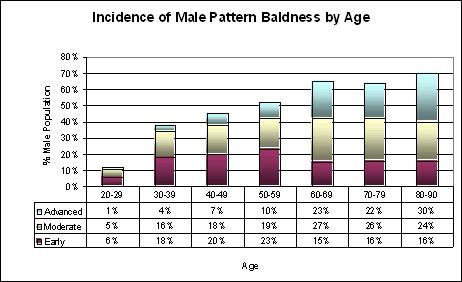
Hair loss is caused by the effects of androgens on susceptible hair follicles. Most men will experience some degree of balding as they age, with more than half displaying signs of genetic baldness by the time they are in their 50s. View this chart to see how the incidence of male pattern baldness increases with a person’s age. The genes for androgenetic alopecia can be inherited from either the mother’s or father’s side of the family.
Visit the section for Men, where we explore the causes and classification of male pattern baldness, how it is diagnosed, and what treatments are available.
Women
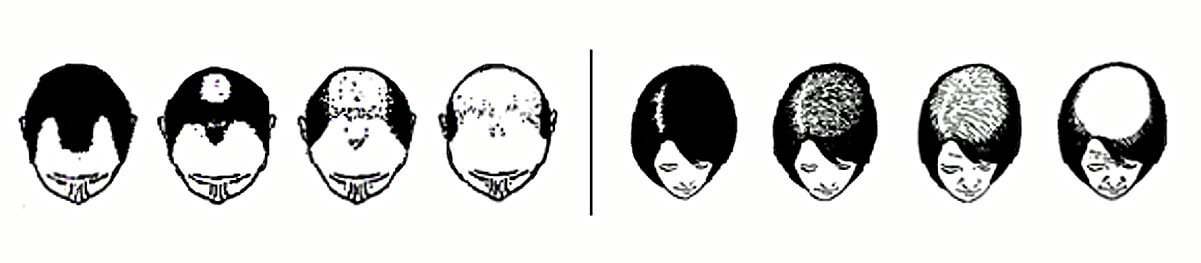
Androgenetic alopecia affects about 30% of women in their lifetime. Because it tends to present as diffuse thinning over the entire scalp, and because women generally do not lose their frontal hairline (as men do), the thinning may not be as noticeable, particularly in its early stages. Women generally lose hair gradually, with the rate accelerating during pregnancy and at menopause.
Women’s hair loss can also show seasonal variations and is more easily affected by hormonal changes, medical conditions, and external factors compared to balding in men.
Visit the section for Women, where we explore the causes, classification, diagnosis, and treatment of women’s hair loss.
Hair Loss Basics
In this section, we review miniaturization, the hormone-driven mechanism of hair loss, and the genetics of hair loss. Dr. Bernstein dispels the top ten hair loss myths and answers frequently asked questions. Also, read about the functions of hair, the anatomy of hair and hair follicles, and the three phases of the hair growth cycle (anagen, catagen, and telogen). Find a glossary of medical terms, discussion on the psychology of balding.