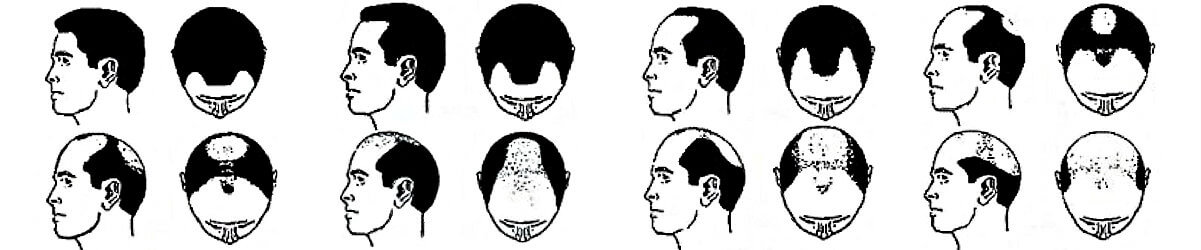
The diagnosis of androgenetic alopecia in men is generally straightforward. It is made by observing a “patterned” distribution of hair loss and confirmed by observing the presence of miniaturized hair in the areas of thinning. Miniaturization is the progressive decrease of the hair shaft’s diameter and length that occurs in response to androgens.
During your consultation, the physician assesses the degree of miniaturization using a hand-held instrument called a video densitometer. This instrument magnifies a small area of the scalp where the hair has been clipped to about 1mm in length.
The below-left image shows a normal scalp, seen through the densitometer, in which the follicular units have full thickness, healthy terminal hairs, with hair shafts of uniform diameter. The below-right image, however, shows a scalp where the hair shafts have decreased in diameter due to miniaturization, a characteristic of androgenetic alopecia.
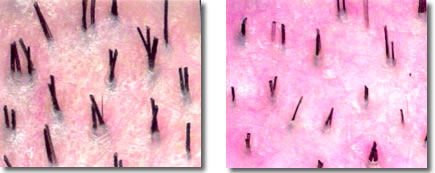
Hairs may be in varying states of miniaturization, but if the follicles are continually exposed to the hormone DHT they will eventually stop producing hairs and the follicles will disappear.
The diagnosis of androgenetic alopecia is supported by a family history of hair loss, although a positive history is not always identified, and the absence of other medical causes of alopecia. In older patients, their own history of passing through the different Norwood stages is strongly suggestive of male pattern alopecia.
Diagnosing Diffuse Hair Loss
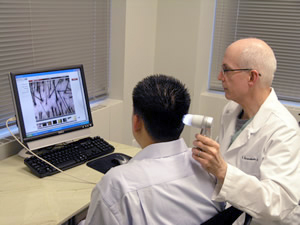 Dr. Bernstein Using the Video Densitometer
The diagnosis of diffuse hair loss can be more difficult because there is thinning all over the scalp rather than confined to specific areas defined by one of the Norwood patterns. However, the presence of miniaturization in the areas of thinning usually confirms the diagnosis of androgenetic alopecia.
If the diagnosis of diffuse hair loss is still unclear after densitometry, a number of other medical conditions known to cause diffuse hair loss must be ruled out, including thyroid disease and anemia. Some drugs used for high blood pressure and depression can also cause hair loss, as can anabolic steroids. When a non-androgenetic cause for diffuse hair loss is suspected, the following laboratory tests are often used to determine the cause: blood chemistries, complete blood count, serum iron, thyroid functions, and tests for lupus and syphilis.
Diagnostic Testing
When the diagnosis of androgenetic alopecia is still uncertain, further diagnostic information can be obtained from a hair-pull test, a scraping and culture for fungus, a microscopic examination of the hair bulb and shaft, and a scalp biopsy. A dermatologic consultation is warranted whenever the cause of hair loss is unclear.