- More about Hair Loss in Women
- Answers
- Video
- Research
- Physician Consult
- Before & After Photos of Female Patients
Hair loss is relatively common in women with about 30% experiencing at least some degree of thinning in their lifetime. However, because female hair loss tends to be diffuse (less hair all over) and because women often maintain their frontal hairline their hair loss may not be noticeable, particularly in its early stages.
The psychological effects of hair loss can be significant for women and many are emotionally affected, even with modest amounts of thinning. This is, in part, due to the false assumption that it is uncommon for women to lose their hair and that hair loss in women is perceived to be socially unacceptable. Both of these erroneous perceptions make dealing with hair loss particularly difficult for women.
In addition, the widely used medication Propecia is not indicated for women, so there is a misconception that medical progress in treating female hair loss is not as advanced, or that the medical community does not take the treatment of female hair loss as seriously. Lastly, because hair loss in women can so often be disguised with existing hair, many women choose to hide their hair loss from others. Not sharing their problem tends to isolate them and makes the ability to deal with their hair loss all the more difficult.
Hair loss in women is generally very gradual, with the rate accelerating during pregnancy and at menopause. It can also show seasonal variations and it is more easily affected by hormonal changes, medical conditions, and external factors.
Causes of Hair Loss in Women
Common or “hereditary” baldness in women, also called female pattern alopecia, is genetic and can come from either the mother’s or father’s side of the family. It is affected by the actions of two enzymes; aromatase (which is found predominantly in women) and 5-alpha reductase (which is found in both women and men). However, since the diffuse pattern of hair loss typically seen in women can be caused by a number of medical conditions other than common genetic hair loss, a thorough evaluation is particularly important for female patients. If an underlying medical cause can be found and treated, the hair loss can often be reversed. Read more about the Causes of Hair Loss in Women.
Classification of Female Hair Loss
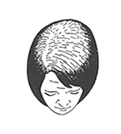
Ludwig Class 2: Moderate Hair Loss
The common diffuse pattern of female hair loss caused by heredity is organized by the degree of thinning. This system of classification for hair loss in women is called the Ludwig Classification. Hair loss in the Ludwig system is labeled as being mild, moderate and extensive. Read more about the Classification of Hair Loss in Women.
Diagnosis of Hair Loss in Women
The diagnosis of “female pattern” hair loss is relatively straightforward when there is a history of gradual thinning in the front and/or top of the scalp, a relative preservation of the frontal hairline, a positive family history of hair loss and the presence of miniaturization in the thinning areas. Miniaturization, the progressive decrease of the hair shaft’s diameter and length in response to hormones, can be identified using a hand-held device called a densitometer.
Besides densitometry, two other common diagnostic tests that can be performed in the physician’s office are the hair-pull (a test for shedding) and the hair pluck (a test for hair damage). If common causes are ruled out, a more thorough diagnosis is called for, which may include blood work, a biopsy, or other laboratory testing. Read more about the Diagnosis of Hair Loss in Women.
Treatment of Hair Loss in Women
Read about the treatment of hair loss in women, including medical treatment, laser therapy, hair transplantation, and camouflage treatments. Treatment of Hair Loss in Women.