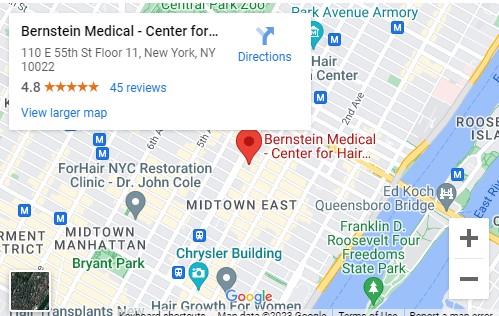
Located in New York City, Bernstein Medical Center for Hair Restoration has been a trusted name in hair loss treatment for years. We offer cutting-edge solutions for individuals experiencing hair thinning, baldness, and hair loss, with services that cater to men, women, and transgender individuals. Our team of experts is dedicated to helping you restore […]
Synopsis: This was the first paper on Follicular Unit Transplantation. This publication introduced into the medical literature the idea of using individual, naturally occurring follicular units exclusively in the hair transplant procedure and stressed using large sessions to maximize the aesthetic outcome. The paper defined the various components of Follicular Unit Hair Transplantation, explained the anatomic and physiologic advantage of using follicular units in the procedure and described how follicular units could be used safely in large numbers to complete the hair restoration as quickly as possible. This publication was instrumental in having hair restoration surgeons shift from the older mini-micrografting techniques to the cosmetically superior technique of using follicular units.
roducing new hairs in two to three months, although at first, the hair tends to be thin and sometimes wiry. At this time, some patients experience “shock loss,” a normal physiological response to scalp trauma in which existing (non-transplanted) hairs fall out in the vicinity of the transplanted hair. While this can be unnerving for patients, it does not imply damage to transplanted follicles, and the existing hairs generally grow back. In the ensuing months, transplanted follicles will produce hairs that grow progressively thicker and appear more like normal hair. At one year, the final result of the procedure can usually be appreciated. During the hair transplant procedure, hair follicles are taken from the part of the scalp that is most resistant to the progression of baldness. The transplanted hair can last for a lifetime; however, unrelated conditions may arise that can damage hair follicles including the hair that is transplanted. This may be caused by a variety of medical disorders, dermatologic conditions, progression of balding beyond the norm, and changes related to aging. Treatment for these conditions can mitigate related hair loss, but may not always be successful. To help you visualize the post-op growth process, we…
Dr. Bernstein is frequently asked about hair transplant procedures for women, and in this video he discusses the differences between treating men and women.
By Robert M. Bernstein M.D., F.A.A.D Hair loss is a problem for millions of men and women, both young and old. It can decrease self-esteem and confidence, and limit the ability to enjoy life to the fullest. Balding affects people in different ways, but certain emotional reactions seem to be shared by many. Hair Loss […]
An important androgen receptor gene is located on the X chromosome There are many theories on the genetics of hair loss. You may have heard the popular myth that hair loss is passed down to men from the mother’s side of the family and to women from their father’s side. These myths travel alongside countless […]
The Norwood system of classification, published in 1975 by Dr. O’tar Norwood, is the most widely used classification for hair loss in men. It defines two major patterns and several less common types. In the regular Norwood pattern, two areas of hair loss gradually enlarge to produce recession at the temples and thinning in the crown. These regions coalesce until the entire front, top and crown (vertex) of the scalp are bald.
d if there is too much wastage in the extraction process, too large an area may be needed to obtain the hair. This can leave a thin look even without shock loss (shedding).
Q: What's your honest take on Nutrafol? It is a product my dermatologist has recommended for my hair loss. -- N.S. ~ New York, N.Y. A: The traditional thinking is that that male pattern alopecia (androgenetic alopecia) is due to follicular sensitivity to DHT causing miniaturization and eventual loss of hair. The premise of Nutrafol is that hair loss is multi-factorial with an important inflammatory component and that it is important to address the inflammation as well as the DHT sensitivity. This is a relatively new and important concept (I would like to stress this point!). However, the big leap is their conclusion: Since hair loss is multi-factorial, then broad, rather than targeted treatments would be most beneficial, and since naturally occurring "phytochemicals" are broader in action than targeted, FDA approved drugs (like and minoxidil), they should offer benefit in the treatment of hair loss and Nutrafol is the elixir that can accomplish this. Although this makes sense in concept, there is no scientific evidence that Nutrafol can actually reverse or/mitigate androgenetic alopecia or any other type of hair loss. We need independent, blinded, controlled studies to show that Nutrafol actually works. Until then, it is very difficult to recommend…
Synopsis: Together with Part I, Basic Repair Strategies, these paired articles define the state-of-the-art in correcting the cosmetic problems that resulted from outdated hair restoration techniques and/or poor surgical planning. This section emphasizes the importance of graft excision and re-implantation prior to camouflage in order to achieve the best outcome. It details the specific techniques needed for the graft excision and explains the aesthetic nuances of the camouflage.

 Hair Restoration in New York City
 Follicular Transplantation
 How Does Hair Transplantation In Women Compare To Procedures For Men?
 What is your Opinion of Nutrafol?