British Vogue Interviews Dr. Bernstein on Women’s Hair Loss and Female Hair Transplants

September 24th, 2012

British Vogue Oct 2012 CoverHair transplantation for women is in vogue. As a pioneer in the surgical treatment for female hair loss, Dr. Bernstein was featured in an article in the ‘Beauty’ section of the October 2012 issue of British Vogue.

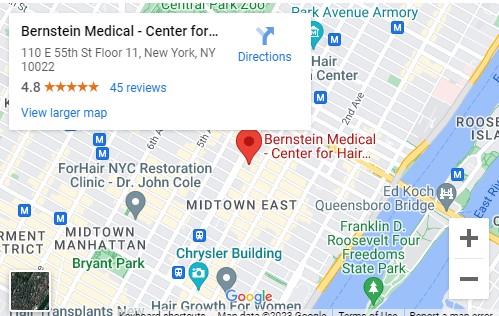
After describing a visit to Bernstein Medical – Center for Hair Restoration in New York City and giving readers a primer on hair transplant surgery, the article turns to Dr. Bernstein to describe the surge in popularity of the treatment of hair loss in women.

“A quarter of my consults are women. It was 10 per cent five years ago,” says Dr Bernstein. “These improved [hair transplant] techniques work especially well for female hair loss, where it is usually localised patches of thinning that need attention.” And while in the chair, you can even have your eyebrows boosted to Arizona Muse quality, too, if they’ve also taken an ageing hit.

Dr. Bernstein speaks to the difficulty of being a woman suffering from hair loss:

“This is life-changing. Bald men are commonplace, but to have less than a full head of hair for a woman can be isolating. Although there are more tricks women can use to disguise the problem.”

The article also discusses a variety of products and techniques to boost hair volume or camouflage hair loss. Among these are: Kérastase, Nicky Clarke’s ‘Tease Me’ powder, Viviscal Hair Nutrition, laser stimulation, Michaeljohn’s ‘Fine Hair Clinic’, and Touché by Flavien.


Rating: 1 Star2 Stars3 Stars4 Stars5 Stars   4.00 stars from 1 vote(s)

Topic:

Tags: , , , , , , , , , , , ,
Posted on September 24th, 2012 at 10:10 am

Can I Stop Medical Treatment For Hair Loss Once Started?

December 15th, 2011

Q: I am taking finasteride as you prescribed. You also suggested using minoxidil liberally over the entire front and top of my scalp once a day. During our meeting I think that you said that once I start using this I would not be able to stop it, and, if I did, it might lead to further hair loss. Hence, I decided to use the laser comb three times a week in addition to the finasteride. Having said that, if you still feel I should start using minoxidil daily, I will start doing so. — H.K., Brooklyn, NY

A: Stopping therapy doesn’t lead to further hair loss in that it doesn’t accelerate it; you just continue on the path that you would have been without the treatment. When you stop, there may be an initial shedding as you quickly lose any benefits that you had from the treatment.

The following applies to all three treatments: finasteride, minoxidil, and laser therapy:

  1. Only work when you use it
  2. Reversion to where you would have been when you stop (but not worse)

However, the important issue is efficacy:

Finasteride >> minoxidil > laser therapy (dubious value)

This is the reason I recommended finasteride and minoxidil.


Rating: 1 Star2 Stars3 Stars4 Stars5 Stars  

Topic:

Tags: , , , , , ,
Posted by Robert M. Bernstein M.D. on December 15th, 2011 at 12:55 pm

Which Handheld Laser Therapy Device Do You Recommend?

October 4th, 2011

Q: I am interested in trying home laser therapy for my androgenic alopecia? Which handheld laser device do you recommend? — N.M., Northfield, NJ

A: There are several handheld lasers currently marketed as a home use treatments for androgenic alopecia. To my knowledge there has never been a clinical study comparing different laser devices. Most of the devices use diodes to emit a narrow band red light. This wavelength of light is actually similar to those that are used in hair removal lasers, except they are at a much lower intensity. The theory is that high intensity laser damage hair follicles causing hair loss, but low level laser energy can have a bio-stimulation effect and actually induce hair growth.

If you would like to try laser therapy for hair loss, I suggest using a HairMax laser comb. This is the only device that is FDA approved. They sell a few different “strengths” of lasers for different costs. They have not shown any clinical evidence supporting one laser comb versus another. The more expensive ones have more diode lights so it would be reasonable to conclude that they are “stronger” and require less frequent use. I have patients who have used the “mid tier” laser comb, the Premium Lux 9 successfully, so that is the one I recommend to other patients.

Read more about Laser Therapy.

Answer courtesy of Dr. Eric Schweiger, an associate at Bernstein Medical – Center for Hair Restoration whose focus is the diagnosis and treatment of female hair loss.


Rating: 1 Star2 Stars3 Stars4 Stars5 Stars  

Topic:

Tags: , , , , , , , , , , ,
Posted by Robert M. Bernstein M.D. on October 4th, 2011 at 5:46 pm

Is Laser Therapy With Hand-held LaserComb Better Than Revage Helmet Unit?

July 21st, 2010

Q: If I want to use a laser to try and stimulate my hair to grow, should I use one of the hand-held units, such as the LaserComb or X5 Laser, or use a helmet?

A: Of the hand-held lasers, I feel the LaserComb is most effective. With the helmet units used in salons or doctor’s offices, we recommend the Revage. There is no evidence that the helmet lasers works any better than the LaserComb.

Some patients prefer a helmet, such as the Revage, since they can just relax and don’t have to worry about using it correctly or concentrating on reaching every spot. Others prefer the hand-held unit, since it is less expensive and can be used at home.

For more on this topic, view our Laser Therapy section.


Rating: 1 Star2 Stars3 Stars4 Stars5 Stars  

Topic:

Tags: , , , , , ,
Posted by Robert M. Bernstein M.D. on July 21st, 2010 at 7:53 am

Laser Therapy

April 28th, 2010
HAIR TRANSPLANT BLOG
Learn more about:

Laser Therapy

Low-Level Laser Therapy (LLLT) in hair restoration utilizes cool lasers to stimulate hair growth and reduce hair loss. LLLT is based on the scientific principle of photo-biotherapy. Photo-biotherapy occurs when laser light is absorbed by cells and stimulates cell metabolism and protein synthesis. Although the exact mechanism by which laser light promotes hair growth is still unknown, it appears to stimulate the follicles on the scalp by increasing energy production and by reversing miniaturization (the process leading to thicker hair shafts and a fuller look).

Laser light is in the visible red light spectrum and is generated in a laser diode. The energy level is far below that of laser beams that cut or burn tissue. The low-level red laser light has a very low absorption rate in human tissue making it safe for use in the treatment of hair loss. The Revage laser emits 670nm of visible red light.

Low energy lasers have been used for over thirty years to accelerate healing after wounds or burns and to reduce pain. In 1992, Pontinen published the first paper discussing its possible use in promoting hair growth. Since then there has been much progress is defining the exact parameters necessary to accomplish this, In 2007, the FDA cleared for marketing the use of low-level lasers for the treatment of androgenetic hair loss in men. This clearance was based on the device’s safety, and not on its effectiveness in treating hair loss.

The HairMax LaserComb, cleared by the FDA as a Class II medical device in January 2007, is a compact version of the larger laser therapy units used by hair clinics in other countries to stimulate hair to increase in thickness and make the hair appear fuller. This home product has teeth that part the hair to potentially enable the laser light to reach the scalp in areas of existing hair.

The Revage Laser System, from Apira Science, utilizes Rotational PhotoTherapy (RPT). The Revage 670 is a Class IIIA diode laser approved by the FDA for cosmetic use. It is a low-level laser system that contains 30 laser diodes that rotate 180 degrees around the scalp. This dynamic process increases the contact of the laser energy with the hair follicles and is potentially more effective than a static system in delivering the laser energy to the scalp. It also eliminates human error and variability in self administration. A potential limitation is the fact that existing hair may interfere with the laser beam effectively reaching the scalp.

The unit may prove to be useful for hair loss in women where the thinning tends to be diffuse or those experiencing telogen effluvium. LLLT can be used safely in conjunction with other medications including Propecia and Rogaine and there are no contraindications which would interfere with hair transplant surgery.

While these cool laser treatments have been approved for use, their long-term effectiveness has yet to be determined. A 12 month program can require treatments from 3x per week tapering to one treatment per month and the results and satisfaction from patients thus far have been sporadic.

For additional information on specific low-level laser systems for hair loss go to HairMax LaserComb, X5 Hair Laser and Revage Laser System.


Rating: 1 Star2 Stars3 Stars4 Stars5 Stars  

Topic:

Tags: , , , , , , , , , , ,
Posted by Robert M. Bernstein M.D. on April 28th, 2010 at 11:36 am



© 2005-2013 Bernstein Medical, P.C. All Rights Reserved.