Posts Tagged: Diagnosis of Hair Loss in Women

Why is Hair Loss in Women Difficult to Diagnosis?

August 4th, 2009

Q: Why is hair loss in women difficult to diagnosis?

A: The majority of hair loss in women is diffuse. This means that the hair thins all over the scalp, rather than on the front and top characteristic of balding in men.

Diffuse hair loss can be caused by a number of things besides genetics; including medical problems such as anemia, thyroid disease, and polycystic ovaries; and medications such as birth control pills, blood pressure pills, seizure medications and blood thinners. Stress and pregnancy can also cause this type of diffuse hair loss.

The hallmark of genetic female pattern hair loss is miniaturization (change in hair shaft diameter).

Hair shedding is characteristic of many of the other conditions, but is less commonly seen in genetic hair loss.

For a complete discussion on hair loss in women, visit the pages for the diagnosis, causes, and classification of female hair loss. Or view photos of our female hair restoration patients for examples of Dr. Bernstein’s work on restoring hairlines, hair at the temples, and eyebrows.

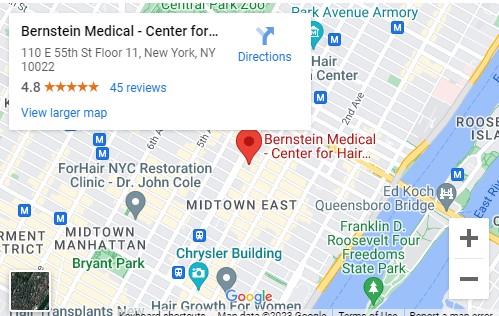
Also, a reminder, Bernstein Medical – Center for Hair Restoration will be holding a Women’s Hair Loss Open House at our facility in Midtown Manhattan, New York City on Wednesday, August 12th, 2009 (4-6pm). You can register to attend the open house by following this link. We look forward to seeing you there!


Posted by Robert M. Bernstein M.D. at 8:10 am

Can Female be Candidate for Follicular Unit Hair Transplant?

February 1st, 2008

Q: I am female and thinning can I be a candidate for a Follicular Unit Hair Transplant?

A: If it turns out that you have female pattern hair loss, you may be a candidate a hair transplant, but would need to be evaluated by a doctor who specializes in surgical hair restoration.

In the evaluation, you should have your degree of hair loss assessed and donor supply measured, using an instrument called a densitometer, to be certain that you have enough permanent donor hair to meet your desired goals. For more information about hair loss in women, please see the Diagnosis of Hair Loss in Women page of the Bernstein Medical – Center for Hair Restoration website.

If you are thinking about your hair loss and would like to be evaluated, go to the physician evaluation page of the Bernstein Medical – Center for Hair Restoration website.


Posted by Robert M. Bernstein M.D. at 7:22 am

What are Pros and Cons of Laser Therapy at Home vs. Doctor’s Office?

April 19th, 2007

Q: I heard that you can buy a laser for hair loss and use it at home. What are the advantages or disadvantages of doing this?

A: The advantages of home use are convenience and that it is generally less expensive than going to a doctor’s office for treatment.

The main disadvantage of using laser treatments without a doctor’s supervision is that a more effective treatment for hair loss may be available and you may not know about it. By spending time using the laser, the window for a more effective treatment may be missed. A good example is the 20 year old male who has extensive hair loss in his family and is just starting to thin. It is very important for this person to start Propecia (finasteride) as soon as possible, since the long-term benefits of using this medication are well established.

Laser treatment at home, without a prior evaluation by a physician, also risks missing the diagnosis of an underlying medical condition. This can be a particular problem in women where hair loss tends to be diffuse and the cause may not be readily apparent. If the cause of the thinning was due to anemia, thyroid, or ovarian disease, the diagnoses of these treatable conditions might be missed.

Finally, the laser therapy available in a doctor’s office may be significantly more effective than a home unit.


Posted by Robert M. Bernstein M.D. at 5:58 am

How Does Densitometer Help Diagnose Hair Loss?

August 17th, 2006

Q: Dr. Bernstein, I was reading about a densitometer on your website. What is it and what is it actually used for?

A: The hair densitometer was introduced to hair restoration surgeons by Dr. Rassman in 1993. It is a small, portable, instrument that has a magnifying lens and an opening of 10mm2.

To use it, the doctor clips the hair short (~ 1-mm) and the instrument is then placed on the scalp. The doctor counts the total number of hairs in the field, looks at the number of hairs per follicular unit and assesses the diameter of the hair, looking in particular for abnormal levels of miniaturization (decreased hair shaft diameter caused by the effects of DHT).

The densitometer can increase the accuracy of the diagnosis of genetic hair loss by picking up early miniaturization.

It can also better assess a person’s donor hair supply, thus helping to determine which patients are candidates for a hair transplant.

Densitometry has helped us define the conditions of diffuse patterned and unpatterned hair loss (DPA and DUPA) and help to refine the diagnosis of hair loss in women.


Posted by Robert M. Bernstein M.D. at 1:18 pm


© 2009 Bernstein Medical, P.C. All Rights Reserved.