January 5th, 2012

 The New York Times, once again, has recognized Dr. Bernstein’s pioneering hair restoration techniques. The NYT Fashion and Style section noted that he is, “the first hair transplant surgeon on the east coast,” to use the ARTAS robotic system for Follicular Unit Extraction.
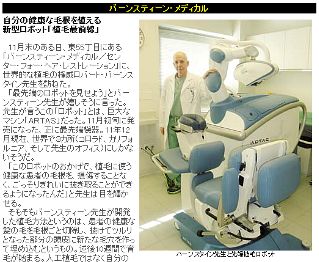 Dr. Bernstein’s pioneering work in developing FUT and FUE hair transplant procedures has influenced hair restoration physicians across the globe. Recently, his use of the ARTAS System for robotic FUE has grabbed international attention, as he was featured in a Japanese magazine.


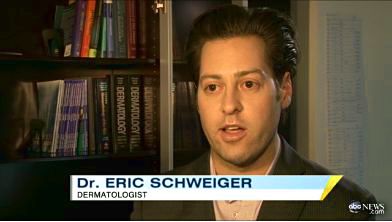 From hair extensions to eyelash enhancement, our resident expert on hair loss in women is on the case. Dr. Eric Schweiger was featured in a segment on Good Morning America where he discussed the enhancement of eyelashes, which he called, “a universal sign of beauty.”
  Dr. Schweiger lends his expertise on