Hair transplantation is an out-patient surgical procedure in which hair is transplanted from the back and/or sides of the scalp (the “donor area”) to areas that are thinning or bald (the “recipient area”). Once transplanted, the hair will generally grow for a person’s lifetime. In addition to treating androgenetic alopecia (common genetic hair loss), surgical techniques can be employed to restore eyebrows, facial hair, and pubic hair, and to repair scars caused by trauma or surgical procedures such as face-lifts and prior surgeries.
All modern hair restoration surgeries are based on a concept introduced by Dr. Bernstein in his groundbreaking 1995 publication “Follicular Transplantation.” In this, and in a series of papers that followed, he proposed that the most aesthetically pleasing outcomes will be produced when individual naturally-occurring bundles of one to four hairs, called follicular units, are transplanted rather than the larger grafts of skin and hair used in traditional procedures. These publications laid the groundwork for modern surgical hair restoration.
Types of Procedures
Follicular Unit Transplantation (FUT)
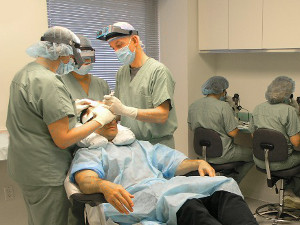 Dr. Bernstein & staff perform FUT
Dr. Bernstein’s breakthrough idea of transplanting only naturally occurring follicular units led him to develop a procedure called Follicular Unit Transplantation (FUT). FUT became the gold standard in surgical hair restoration and is still performed around the world. In FUT, the patient’s scalp is numbed using local anesthesia, and a strip of skin is removed from the donor area. This “donor strip” is subsequently dissected with the aid of special stereo-microscopes into hundreds or thousands of grafts, each of which contains an individual follicular unit. The donor area is sutured or stapled closed to produce a very fine linear scar. With the patient still under local anesthesia, the surgeon creates hundreds to thousands of needle-sized holes, called recipient sites, in the balding area. One follicular unit graft is placed into each of these sites.
A typical FUT procedure takes between five and eight hours depending on the number of grafts transplanted. FUT is particularly beneficial for patients who desire maximum volume and fullness and who do not plan to wear their hair very short.
Follicular Unit Extraction (FUE) & Robotic FUE
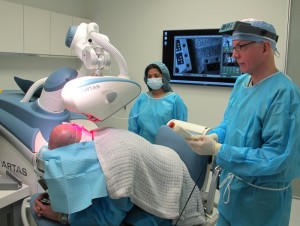 Dr. Bernstein performing Robotic FUE
Dr. Bernstein pioneered Follicular Unit Extraction (FUE) in 2002 (with his colleague Dr. William Rassman) and robotic-assisted FUE (Robotic FUE) in 2011. In FUE, follicular units are removed one-by-one directly from the donor area using a small, round cutting instrument. As with FUT, the grafts are then implanted one-by-one into recipient sites in the balding scalp. The small holes that remain from the extraction are left open to heal, which takes about a week, with each producing a tiny, round, white scar. There are a variety of manual and motorized instruments for FUE, including the Neograft and the SAFE System.
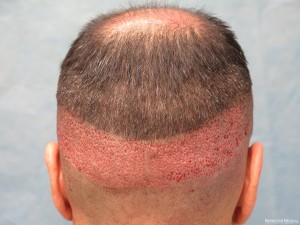 Donor area immediately after robotic harvesting
Robotic FUE, which uses the ARTAS® Robotic System to extract follicular units and create recipient sites, has taken FUE to new levels of precision and reliability. The automation of the FUE procedure by the ARTAS robot contributes to the overall improvement of the surgery in a number of ways, but especially by reducing human error in the surgical process. All FUE hair transplant procedures at Bernstein Medical use the robotic system. FUE takes five to twelve hours, with longer procedures performed over two consecutive days. They are typically beneficial for patients who wear their hair cropped very short, who are a risk of a widened scar, or who need to return to strenuous exercise or activity shortly after the procedure.
In both FUT and FUE, transplanted follicles begin producing new hairs in two to three months and the results of the procedure will be fully grown-in, or “mature,” after about one year. We schedule a one-year follow-up meeting at this time.

Candidacy for Surgery
Surgical hair restoration should only be performed on appropriate candidates. This assessment occurs during a hair loss consultation with a physician. In order to be a candidate, five basic criteria should be met. These include:
- A diagnosis of androgenetic alopecia (common genetic hair loss) or another condition that is amenable to surgical hair restoration
- First explored medical therapy and, if appropriate, given adequate time to see a full response (generally one year)
- Sufficient hair loss that it affects their aesthetic appearance
- Adequate donor hair to satisfy current and future needs
- Realistic expectations on what surgical hair restoration can accomplish
What Age to Consider Surgical Hair Restoration
Young patients should not consider surgery as a technique to prevent hair loss, as it does not block the hormones that cause genetic balding. Rather, hair surgery is a restorative treatment to improve your appearance if other modalities have been unsuccessful or can’t be used.
There are no medical or surgical benefits to having a procedure at a young age. In fact, transplanting hair in young patients can create issues for the patient in the long term, such as depleting their finite supply of donor hair by distributing hair in the wrong areas of the scalp. Some young people will experience thinning in their donor area when they mature, and transplanting one of these people when they are young will most likely result in an unsatisfactory outcome. Unfortunately, this condition, called diffuse un-patterned alopecia or DUPA, cannot always be identified at a young age. As a result of these considerations, transplantation is not advised in patients younger than 25 and it is best to wait significantly longer.
Candidacy in Women
With female patients, it is important for the physician to ensure that the patient’s donor area is stable and not prone to thinning. Comprehensive diagnostic testing is often required to rule out underlying medical conditions, medication, or pregnancy as the cause of the hair loss; confirm the diagnosis of androgenetic alopecia, and determine if the patient is a candidate for surgery.
Consultation for Surgical Hair Restoration
Every patient at Bernstein Medical must have a one-on-one consultation with a board-certified hair restoration physician to determine if they are a candidate for a hair transplant. At the consultation, the doctor will listen to the patient’s concerns regarding their hair loss, take a careful medical history, and ask about their expectations for the hair restoration. The patient will have plenty of opportunity in the consult to ask questions about their hair loss and how best to treat it.
Densitometry & Miniaturization
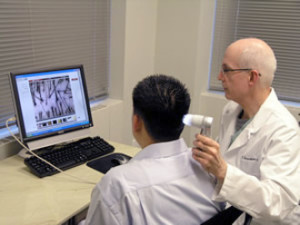 Dr. Bernstein using densitometer during a hair loss consultation
During the consultation the doctor may examine the patient’s scalp using a video densitometer, a device that magnifies the scalp, enabling the physician to see the quality of the individual follicular units. It is connected to a computer monitor so the patient can watch as the physician inspects their scalp. The densitometer helps the doctor determine the patient’s hair density (hairs per square centimeter) and the degree of “miniaturization” of those hairs. In miniaturization, hair follicles that are genetically susceptible to the effects of the hormone dihydrotestosterone (DHT) shrink over time eventually leaving a bald scalp. The degree to which hairs are miniaturized can indicate future hair loss. If hair follicles in the crucial donor area show signs of miniaturization, the patient may not be a suitable candidate for surgery because transplanted miniaturized hairs may eventually be lost.
Design & Planning
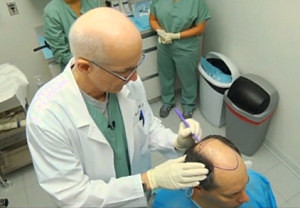 Dr. Bernstein developing hair restoration plan
During the consult, the physician will begin to make the necessary aesthetic judgments to formulate the design. These judgments include how best to distribute a finite amount of donor hair for maximum cosmetic effect, how to design the hairline, and how to restore the crown (when appropriate). The transplant design should be made in collaboration with the patient’s needs, but the plan must be a realistic one, taking into account future hair loss and the fact that everyone’s donor supply is finite.
The Procedure
Hair transplantation is a minimally-invasive surgical procedure performed under local anesthesia in the doctor’s office or outpatient facility. A typical session entails the extraction and placement of 300 to 3,000 follicular unit grafts. Procedures can last eight hours or more and the longest ones are performed over two consecutive days. How long the procedure takes depends on the number of follicular units transplanted and the type of procedure used, with FUE generally taking longer than FUT.
Pre-op
There are some minor preparations that must be followed in the days and weeks before surgery. Pre-op instructions include abstaining from smoking and aspirin one week before surgery and abstaining from alcoholic beverages for three days prior to the procedure. Instructions for the day of your procedure include showering and shampooing that morning and abstaining from caffeinated beverages. It is important to arrange for transportation following surgery as sedatives may be used that will preclude the patient from driving. These instructions differ slightly when preparing for FUT and FUE. We provide the complete instructions on our website in HTML and as a PDF download. Patients receive the instructions from the office as well.
The Surgical Procedure
On the day of your procedure, after reviewing the goals for your hair restoration, the doctor will re-draw the hairline position that was determined at your consultation. You will have the chance to examine and discuss the plan before the surgery. Once you are ready, comfortable, and sedated (if you opt for it) the procedure will begin. There are three main steps to the transplant: follicular unit harvesting, recipient site creation, and graft placement.
Follicular Unit Harvesting
The first major step is harvesting follicular units from the donor area. In FUT hair transplants, the surgeon will excise a thin strip of hair-bearing tissue from your donor area and suture or staple it closed. The strip is then dissected into follicular units by a team of experienced technicians. In FUE, individual follicular units are extracted from the donor area one-by-one. This is the step that can best be done robotically. You can read a detailed overview of FUT here and Robotic FUE here.
Recipient Site Creation
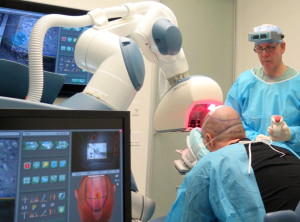 Recipient site creation with the ARTAS Robot
The second major step is creating recipient sites – the tiny holes in the balding area where the harvested grafts are placed. In FUT and manual FUE procedures, the physician uses a needle to create hundreds to thousands of sites in the recipient area of the scalp. This must be done with precise aesthetic ideas in mind because proper recipient site creation is critical to the cosmetic outcome. Some of the considerations in recipient site creation include the angle and depth of the incision, the size of the site, the density of sites, and the distance away from existing hairs. In Robotic FUE, a recipient site creation plan is programmed in advance by the surgeon, then the ARTAS Robot executes the site creation plan according to the exact specifications. It carries out this complex task with microscopic precision thanks to its advanced optical guidance technology. In performing site creation, the robot automates another part of the hair restoration procedure that can be prone to human error.
Graft Placement
Once recipient sites are created, special forceps are used to insert the follicular unit grafts into these sites. This step must be performed with care since mechanical injury to the graft or improper insertion into the site can inhibit growth. The ARTAS Robot does not yet have graft placement capability, so at this time all procedures require a skilled and experienced team to manually place the grafts.
Post-op
It is important that patients follow the post-operative instructions to ensure optimal healing and growth of the transplant. These include shampooing your scalp three times the day after your procedure (yes it can be done this soon), showering twice a day for the first week, and abstaining from alcohol for three days and smoking for two weeks after the procedure. Read and download detailed post-op care instructions for your FUT transplant here or your FUE transplant here.
Post-op Growth
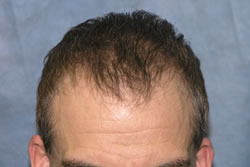
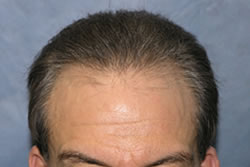
Following the procedure, the growth of hair follows a specific sequence. Although the actual timing of each step is quite variable, for most patients it takes about a year to see the final outcome of the hair restoration. Less commonly, it can take up to two years to see the final cosmetic result.
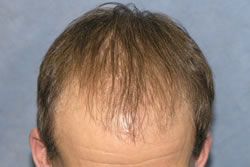 2 months post-op
 6½ months post-op
 12 months post-op
Soon after the surgery, transplanted follicles respond to the “insult” of the transplant by shedding the hairs they contained at the time of the transplant. The hairs may be lost, but the follicles themselves remain, and just 10 days after surgery they are permanently rooted in the scalp. They generally begin producing new hairs in two to three months, although at first, the hair tends to be thin and sometimes wiry. At this time, some patients experience “shock loss,” a normal physiological response to scalp trauma in which existing (non-transplanted) hairs fall out in the vicinity of the transplanted hair. While this can be unnerving for patients, it does not imply damage to transplanted follicles, and the existing hairs generally grow back.
In the ensuing months, transplanted follicles will produce hairs that grow progressively thicker and appear more like normal hair. At one year, the final result of the procedure can usually be appreciated.
During the hair transplant procedure, hair follicles are taken from the part of the scalp that is most resistant to the progression of baldness. The transplanted hair can last for a lifetime; however, unrelated conditions may arise that can damage hair follicles including the hair that is transplanted. This may be caused by a variety of medical disorders, dermatologic conditions, progression of balding beyond the norm, and changes related to aging. Treatment for these conditions can mitigate related hair loss, but may not always be successful.
To help you visualize the post-op growth process, we have created the Hair Transplant Photo Journal. On that page, you can follow the progress of a patient from the planning of the surgery, to recipient site creation, through the maturation of the results, and then to the planning and execution of his second procedure.
Other Applications for Surgical Hair Restoration
Repair Procedures
Surgical hair restoration techniques can be used to correct the appearance of poorly executed transplants, old “hair plug” procedures, scalp reductions, flaps, or widened donor scars. In camouflage procedures, follicular units are implanted around the plugs or scars to hide them. In a graft excision, large pluggy grafts — which can contain several follicular units — are removed and dissected into individual follicular units. These are re-implanted into balding areas, turning a row of unnatural-looking plugs into a more natural hairline. In “combined repair” procedures, both of these techniques are used to achieve the most natural look. Many patients in need of repair procedures have very limited donor hair reserves, so each step in the repair process must be performed with extreme care. Read about corrective methods, and the situations in which each would apply, in the Repairs section.
Eyebrow Transplant & Restoration
The specific anatomic features of eyebrows require special techniques to create natural-looking results in this cosmetically most important area. Fortunately, due to the limited amount of hair needed in eyebrow restoration, most patients will have adequate donor hair if they are candidates for the procedure. Read more in the Eyebrow Transplant & Restoration section.
Hair Restoration History
- Read About
- Old vs. New Procedures
- The first surgery for male pattern baldness was performed by Dr. Norman Orentreich in 1952 in New York City. He formally introduced surgical hair restoration in his 1959 publication, “Autografts in alopecias and other selected dermatological conditions.”
- From the 1960s through the early-80s, Orentreich’s procedure used 3-4mm grafts that became known as “hair plugs.”
- In 1984, it was first proposed to use smaller grafts (mini-grafts) cut from a strip of tissue taken from the donor area. Physicians began using “micro-grafts” of one to two hairs to soften the frontal hairline, and by the 1990s use of “mini-micro graft” techniques resulted in a phasing out of the “plug” procedures.
- In 1995, Dr. Bernstein introduced the idea of transplanting exclusively naturally-occurring follicular units in his landmark paper, “Follicular Transplantation.” Since then, all modern hair restoration surgeries have been based on this concept.
- By 2000, Follicular Unit Transplantation (FUT) had become the “gold standard” technique for thousands of patients worldwide.
- Along with his colleague, Dr. William Rassman, Dr. Bernstein introduced Follicular Unit Extraction (FUE) to the medical literature in a 2002 publication titled “Follicular Unit Extraction: Minimally Invasive Surgery for Hair Transplantation”.
- In 2004, Dr. James Harris introduced a two-step sharp/dull punch instrument for FUE which is important in minimizing damage to the follicular units during extraction.
- In 2011, Restoration Robotics, Inc., introduced the ARTAS Robotic System, the first and only robot for use in FUE. In the fall of 2011, Bernstein Medical became one of the first hair restoration facilities in the world to perform Robotic FUE using the ARTAS Robot. The robot uses the two-step sharp/dull punch tool.
- Since 2011, Dr. Bernstein has collaborated with Restoration Robotics to improve the robot’s performance and develop other applications of the robot. Bernstein Medical is a beta-testing site for Restoration Robotics, and it was in our New York City facility where Dr. Bernstein débuted robotic recipient site creation and automated follicular unit graft selection, along with many other hardware and software upgrades.
Dr. Bernstein’s pioneering research and publications on FUT, FUE, and Robotic FUE have revolutionized the field and have led to the modern techniques that are now used by physicians around the world. Visit our Other Resources section for a detailed history of surgical hair restoration, milestones in the development of FUT, a timeline of innovations at Bernstein Medical, a glossary of important terms, and more.
Follicular Unit Transplants (FUT)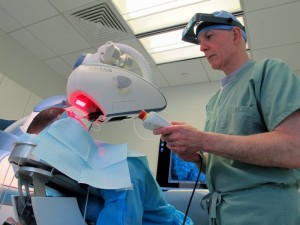 Robotic Hair Transplants (Robotic FUE)