How Does PRP Work for Hair Loss?
PRP Candidacy
Benefits of PRP
What to Expect
Does PRP Prevent Hair Loss?
Book a Consultation
Frequently Asked Questions
Hair loss can be a frustrating and emotionally challenging experience, but effective solutions are available. At Bernstein Medical Center for Hair Restoration, we offer platelet-rich plasma (PRP) therapy, a non-surgical, minimally invasive treatment that uses your body’s own healing power to promote hair regrowth. If you’re looking for a clinically supported, natural approach to hair restoration, PRP hair treatment may be the ideal solution.
What is PRP Hair Treatment?
Platelet-rich plasma (PRP) therapy involves isolating and concentrating the platelets from a small sample of your own blood. Platelets are rich in growth factors that promote cell regeneration and tissue healing. When injected into the scalp, PRP stimulates dormant or weakened hair follicles, extending the hair growth cycle and enhancing the thickness and density of your hair.
The science behind PRP is well-established in orthopedics, dermatology, and now hair restoration. At Bernstein Medical Center, we use advanced centrifugation technology to ensure the highest concentration of growth factors for maximum effectiveness.
How PRP Treatment for Hair Loss Works
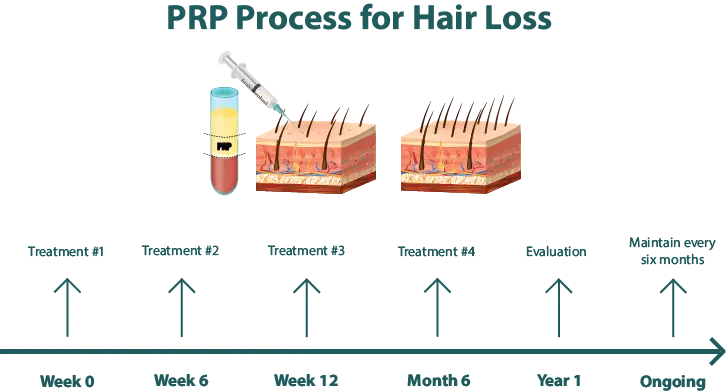
The process begins with a standard blood draw, typically from your arm. This blood is then placed in a centrifuge, where it is spun at high speeds to separate the platelet-rich plasma from other blood components. Once the PRP is prepared, our providers inject it into targeted areas of your scalp.
Critical to efficacy of PRP is the amount of blood that is drawn from a patient. The highest quality PRP systems will remove large amounts of blood, which will proportionally give the patient more platelets, and thus more growth factor. While many offices offer PRP, it is important to know that not all PRP will be the same quality. At Bernstein Medical, we provide high quality PRP to achieve the strongest result.
Each PRP session typically lasts about 30 to 60 minutes, and since the treatment uses your own blood, there is minimal risk of allergic reaction or other side effects. Most patients begin to notice improvements in hair texture and thickness within a few months, with optimal results visible after three to four sessions.
Who Is a Candidate for PRP for Hair Loss?
PRP therapy is a treatment for androgenetic alopecia, also known as male or female pattern genetic thinning. It can off-label be used for conditions of shedding such as stress-induced hair loss (telogen effluvium) and post-partum hair loss.
While PRP is effective on its own, it may also be combined with other hair restoration treatments such as oral medications (finasteride, minoxidil), topical medications, ALMA-TED, and hair transplantation.
Benefits of PRP Injections for Hair Loss
At Bernstein Medical Center for Hair Restoration, patients often choose PRP because it offers a wide range of benefits:
- Minimally invasive, no surgery required
- No downtime after treatment
- Uses natural growth factors from your own blood
- Improves hair density, texture, and strength
- Safe for most skin types and ages
- Complements other hair restoration treatments
PRP is especially attractive for patients who want a more natural alternative to pharmaceutical or surgical solutions.
What to Expect During and After PRP Therapy
The procedure is relatively quick and requires no anesthesia. You may feel slight pressure or mild discomfort during the injections, but the treatment is generally well tolerated. After the session, most patients return to their normal activities immediately. You may experience mild redness or sensitivity in the treated area, which typically resolves within 24-48 hours.
For best results, we recommend a treatment plan that includes an initiation cycle of 3 sessions spaced 6 weeks apart, followed by a session once every 6 months beginning at month 6. Results will be assessed at 1 year after initiation.
Does PRP Prevent Hair Loss in the Future?
One of the most powerful advantages of PRP therapy is its ability to slow or even halt the progression of hair thinning when started early. By stimulating weakened follicles and prolonging the anagen (growth) phase of the hair cycle, PRP not only helps regrow hair but can also prevent further loss in at-risk areas. This preventative effect is especially valuable for individuals with a family history of hair loss or those in the early stages of androgenetic alopecia. When incorporated into a long-term care plan, PRP can serve as both a restorative and protective strategy for maintaining fuller, healthier hair over time.
Why Choose Bernstein Medical Center?
Bernstein Medical Center for Hair Restoration is a pioneer in the field of hair restoration. Our team of board-certified physicians and hair restoration specialists is committed to providing the highest standard of care through evidence-based, customized treatment plans. With decades of experience and a reputation built on integrity, innovation, and patient satisfaction, we are proud to offer PRP therapy as a cornerstone of our non-surgical hair loss solutions.
We don’t just treat hair loss, we help patients regain their confidence, self-image, and quality of life. Every treatment at our center is tailored to meet your unique needs, hair pattern, and aesthetic goals.
Start Your Hair Regrowth Journey At Bernstein Medical
Hair loss doesn’t have to be permanent. With PRP therapy, you can harness your body’s own healing power to restore your hair and your confidence. At Bernstein Medical Center for Hair Restoration, we are here to support you every step of the way with expert care and proven solutions.
Ready to take the first step? Contact us today to schedule your consultation and find out if platelet-rich plasma for hair loss is right for you. Let’s work together to bring back the hair you love and the confidence you deserve.
FAQs About PRP Hair Treatment
How long does it take to see results from PRP injections for hair loss?
Most patients notice visible improvements in hair thickness and texture at one year after initiation of PRP, with ongoing progress over the following months.
Is PRP treatment for hair loss permanent?
While PRP promotes natural hair growth, maintenance treatments are often necessary every 6 months to sustain results. Hair regrowth varies by individual and may be influenced by underlying causes of hair loss.
Are there any side effects from PRP hair treatment?
Side effects are minimal. Some patients experience mild tenderness, redness, or swelling at the injection site, which typically resolves within a day. Because PRP uses your own blood, there’s a very low risk of allergic reactions or complications.
Can PRP therapy be used with other hair restoration treatments?
Yes. PRP can complement other treatments such as finasteride, minoxidil, ALMA-TED or hair transplants to enhance overall results. Our providers will design a customized plan based on your specific needs.