About Trivellini
The Trivellini FUE device is Bernstein Medical’s preferred method for manual FUE. The Trivellini punch device is efficient with extraction of grafts, while maintaining high quality. It has a two-step oscillation process that minimizes tissue damage, and a “Smart React” function that eliminates the need for a foot pedal allowing excellent focus on hand movements.
With the manual FUE procedure, follicular units are removed one– by– one directly from the donor area using the Trivellini punch device to minimize injury to follicles.
For those interested in the technical features of the Trivellini system—such as its customizable modes and ergonomic design—you can learn more about it by visiting the Trivellini Tech website.
At Bernstein Medical, we offer both robotic and manual FUE procedures. While both are excellent methods for hair restoration, there are some key differences between the two:
| Feature | Robotic ARTAS FUE | Manual Trivellini FUE | ||||
| Operator | A physician directs the robotic arm to select each graft, and grafts are then extracted by our skilled technicians under physician supervision and then examined under the microscope for quality | The provider performs the extraction directly by hand and then the grafts are examined under microscopes for quality | ||||
| Hair Type | Works best on straight, dark hair. Hair can be dyed the morning of the procedure, if needed. Average and coarse hair is preferred. | Works well with most hair types and is particularly useful for curled hair since hand motions can mimic curl better | ||||
| Precision | Consistent, image-guided extraction | Real-time adjustments by the provider allow for flexibility with different hair types | ||||
| Speed | Usually faster, and consistently accurate, for large cases | Slightly slower, but allows for greater control in smaller cases; can be fatiguing in larger surgeries | ||||
| Technology | Uses robotic imaging and mapping | Uses a lightweight, handheld device with features, such as “Smart React” that allows the provider to focus on hand movements without the need of a foot pedal | ||||
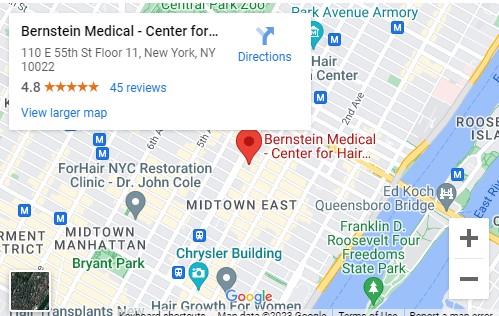
All our hair restoration procedures are performed under local anesthesia in our Midtown Manhattan office. The surgery will take a full day, and medications are given to relax you and make the time pass more quickly. For a portion of the day, you will be able to listen to music, watch TV or a movie, or just relax and sleep while the procedure is going on.
After the procedure, you will leave the office with a bandaged headband, surgeon’s cap, and bandana to cover the transplanted area. These can be removed once you are home. You will be given instructions on how to care for the area after surgery.
The Trivellini Procedure
Once you arrive for your procedure, the staff will go over everything that will take place for the day. A surgical consent form will be sent to you prior to your procedure and will be reviewed on the day of your procedure. You will then meet with the physician and together we will review the established goals and answer any questions you might have. The physician will re-draw the hairline discussed and agreed upon during your consultation, and you will have a chance to discuss and examine your hairline before any medications are given. The physician will then document the agreed upon hairline with high-quality photographs that will become part of your medical record.
You will be given sedatives to help relax before the start of the procedure. At this time, you can choose to watch movies, TV, listen to music, or just relax and sleep. Sedatives will be given throughout the day as needed or requested.
The length of procedure is dependent on the number of follicular grafts needed. Plan to be with us for most of the day, starting at 7:15 am.
We aim to provide a friendly, relaxed environment so that your time here is both pleasant and goes quickly. You will be provided with lunch and be able to take breaks as needed to use the restroom, stretch, or to just move around. Our staff has years of experience assisting in these procedures and are experts at prioritizing your comfort throughout your time with us.
We take every precaution to protect both our patients and our team from blood-borne pathogens during hair transplant procedures. For everyone’s safety, both patients and staff are regularly tested. All instruments are cleaned and sterilized using an autoclave or are single-use and disposable.
Local Anesthesia
After your sedatives are administered, both orally and intra-muscularly, we will start the anesthesia process. The anesthesia used is a combination of local anesthetics Lidocaine (Xylocaine) and Bupivacaine (Marcaine). We will use a vibration device on the skin during anesthesia administration to help alleviate some of the discomfort of the injections. Anesthesia will be administered only to the scalp’s perimeter to make it numb. This is called a ring block. Once the scalp is numb, it will remain numb for 5-6 hours, making the procedure painless. If more anesthesia is needed, it will be administered before the initial ring block wears off.
Donor Tissue
With the manual FUE, the donor area will be shaved to a length of 1-1.2mm. This will include a broad area at the back of the scalp and may include the sides of the scalp as well, if a higher number of grafts are required.
You will be laying down with your forehead resting on a special headrest designed to make the extraction process as comfortable as possible. The provider will begin the extraction, selecting optimum follicles one– by– one. Once the follicles have been extracted, the grafts are placed in a holding solution consisting of Ringers lactate and then placed in a chilled solution of HypoThermosol and ATP. These fluids are formulated to closely mimic the body’s natural fluids. This process helps ensure the highest possible survival rate of the grafts during harvesting.
Once all the harvesting has been completed, the donor area is then covered with petroleum ointment, and a dressing will be applied.
Stereo-Microscopic Dissection
In manual FUE, the extracted grafts are placed under a microscope and carefully examined to determine their integrity and are then sorted by the number of hairs they contain.
If a single follicular unit is needed, such as with the frontal hairline or eyebrow restoration, we can carefully dissect the graft into singular units to complete a soft natural look.
Creating Recipient Sites
For our procedures, we use lateral (perpendicular slits) made with 21 and 19-gauge hypodermic needles for the recipient sites. . The creation of the recipient sites determines the aesthetic look of the transplant as it determines the angle at which the new hair grows and the distribution and density of the grafts. Recipient site creation is a critical aspect of hair transplant surgery that requires considerable experience, surgical skill, and a keen aesthetic sense.
When making sites, the physician can work in and around your existing hair so that it does not need to be cut. This is helpful so that you can use your hair to camouflage the transplanted area during the immediate post-op period.
Graft Insertion
Once all the recipient sites are made, the surgical team will begin to place each follicular unit grafts into the pre-made sites. The one-hair follicular grafts are used in the frontal hairline to create a soft, natural appearance, while the 3 and 4-hair units are placed in the center forelock to achieve fullness. While the grafts are being placed, you will be able to watch TV or movies, listen to music, or just sleep. You can take breaks as often as needed to stretch or use the restroom.
At the End of the Manual FUE Procedure
When the placement of all the grafts is complete, the position of all the grafts will be double-checked. At this time, the post-operative instructions will be read aloud to you, and a copy of it will be provided for you to take home. Included with the instructions will be all the items needed in your post-operative care, along with the doctor’s cell phone. .
You will leave the office with a pressure bandage that will be placed around the donor area and a bandana to cover the bandage. A baseball cap can be worn the next day but will not fit over the bandages immediately after your procedure. Bandages or dressings are not required on the transplanted area, and all dressings can be removed the following morning. You will be escorted by one of our staff members to meet your car service or the person picking you up, and you will receive a call or email from our office the following day to answer any remaining questions you might have.