Q: Why go to a hair restoration practice that specializes in both FUT and FUE? — L.P., Bayside, NY
A: This is a great question, but the answer may be counterintuitive in today’s age of specialization. The answer is that you should always go to the practice that offers both. To deliver the best care, hair restoration physicians should have expertise in both Follicular Unit Transplantation (FUT) and Follicular Unit Extraction (FUE) techniques and should offer both in their practices. There are at least five good reasons why:
1. FUT and FUE are both excellent techniques, but have different indications for their use; therefore, a patient might benefit from one technique over the other. If the doctor offers both procedures, the physician will be able to choose the best one for the specific patient rather than treating everyone with a single type of procedure.
The main advantage of FUT is that it typically gives the highest yield of hair. Therefore, when the patient’s primary goal is to achieve maximum fullness, FUT should be performed. There are many well-described reasons for this, including the precision of stereo-microscopic dissection (which helps preserve follicles and the protective tissues around them) and the ability to harvest efficiently from a more select area of the donor zone.
The main advantage of FUE is no linear scar. Therefore, when the patient’s primary goal is to be able to wear his hair very short, FUE should be performed. FUE is also indicated when there is an increased risk of a widened scar or when scalp laxity does not permit a strip excision. The patient may sometimes choose FUE simply to avoid the stigma of a linear donor scar.
2. The same patient may benefit from both procedures
There are situations in which both procedures are useful in the same patient. For example, FUT may first be used to maximize yield, but then, after several sessions, the scalp may become too tight to continue to perform FUT, or the donor scar may become wider than anticipated. In the former case, the physician can switch to FUE to obtain additional grafts; in the latter case, FUE may be used to camouflage the scar of the FUT procedure.
3. There is a cross-over set of skills from FUT to FUE
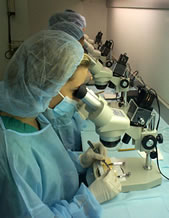
To do an FUE procedure well, the follicular unit grafts that are extracted should be examined carefully under a stereomicroscope and, when needed, trimmed and sometimes subdivided into individual hair follicles (such as for hairlines, eyebrows, temples, etc.). Stereo-microscopic dissection is basic to FUT and is a skill that is second-nature to the staff of hair restoration practices that regularly perform FUT procedures, so this critical step will not be hit or miss. A doctor and staff who perform only FUE will often lack this skill.
4. Practices that offer both procedures are usually more experienced
It is easier to learn and train one’s staff in just one hair transplant technique. In particular, FUE procedures require a smaller staff than FUT and, thus, many doctors entering the field of hair restoration surgery will perform FUE, but not master the skill or make the commitment (financial, time, and infrastructure) to hire and train the staff to perform FUT.
5. Better decision making
One could argue that if a doctor performed only one procedure, but the patient needed the other, then he/she would refer the patient to a colleague. Although this sounds nice in theory, it is very rare for a doctor to refer a surgical case to a colleague if it is a condition that he/she actually treats. More likely, the doctor will convince the patient (and probably himself) that the procedure he offers is the appropriate one, even though it may not be the case.
Posted by
 New York, NY — Robert M. Bernstein, M.D., F.A.A.D., world-renowned pioneer of the hair transplant techniques,
  The New York Times interviewed Dr. Bernstein for a full-length article on hair loss and hair transplant options for women interested in hair restoration. The article – titled, “Tricks and Transplants for Women’s Hair Loss” – covered modern hair transplantation techniques, hair transplant costs, camouflage techniques, and more.
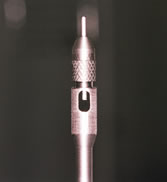 In a new article appearing on the cover of Hair Transplant Forum International, the official publication of The International Society of Hair Transplant Surgeons (ISHRS), pioneering hair transplant surgeon Robert M. Bernstein MD, along with his colleague Dr. William R. Rassman, recently revealed details about a “New Instrumentation for Three-Step Follicular Unit Extraction.”
 Dr. Bernstein received the 2001 HairSite.com award for excellence in hair transplantation. Here is the statement they made in giving Dr. Bernstein the annual award:
 College of Physicians and Surgeons, New York.