Hair Replacement, Hair Transplants, Repair
110 East 55th Street, New York, NY
Telephone: 212.826.2400                        Bookmark This Page
Schedule Physician Consult   
Bernstein Medical - Information About Hair Cloning and Hair Multiplication

Hair Cloning UpdatesGlossary

Hair Cloning and Genetic Engineering

What is Cloning?


Learn more about
Hair Cloning in the
Hair Transplant Blog
Cloning is the production of genetically identical organisms. The first clone of an adult animal was Dolly, the famous Edinburgh sheep. Although technically not an exact replica of her mother (and therefore not a true clone), the revolutionary part of the experiment was that it overturned the long-held view that non-sex cells of an adult (somatic cells) were differentiated to such a degree that they lost any potential to develop into a new adult organism. Scientists had believed that once a cell became specialized as a lung, liver, or any other type of adult cell, the change was irreversible as other genes in the cell became permanently inactive. The other major challenge was to be able to initiate the multiplication of the genetically altered cell and then to provide the proper environment in which the growth of the new organism could take place.

With Dolly, scientists transferred genetic material from the nucleus of a donor adult sheep cell to an egg whose nucleus, and thus its genetic material, had been removed. This egg, containing the DNA from a donor cell, had to be treated with chemicals or an electric current in order to stimulate cell division. Once the cloned embryo reached a suitable stage, it was transferred to a very hospitable environment – the uterus of another sheep – where it continued to develop until birth.

Cloning vs. Genetic Engineering

In contrast to replicating whole organisms, in genetic engineering, one alters the DNA of a particular cell so that it can manufacture proteins to correct genetic defects or produce other beneficial changes in an organism. The initial step in genetic engineering is to isolate the gene that is responsible for the problem. The next step is to clone (multiply) the gene. The last step is to insert the gene inside the cell so that it can work to alter bodily function.

The first gene causing hair loss in humans was discovered by Dr. Angela Christiano at Columbia University. Individuals with this gene are born with hair that soon falls out (as infant hair often does) but then never grows back. They mapped the disease to chromosome 8p21 in humans and they actually cloned a related hairloss gene in mice. Although a huge step forward, this gene is not the same as the one(s) that cause common baldness. Luckily, Dr. Christiano’s lab continues its work to isolate the genetic material responsible for androgenetic alopecia. We will keep you posted on their progress.

A new drug that is an activator of the “Hedgehog pathway” has been shown to stimulate hair growth in adult mice. The study showed that a topically applied medication can initiate the Hedgehog signaling pathway to stimulate hair follicles to pass from the resting to the growth stage of the hair cycle in mice. This technology has not yet been applied to humans. (See Hedgehog and Hair Growth)

What is Hair Multiplication?

In hair multiplication, hairs are simply plucked from the scalp or beard and then implanted into the bald part of the scalp. The idea is that some germinative cells at the base of the hair follicle will be pulled out along with the hair. Once the hair is re-implanted, these cells would be able to regenerate a new follicle. In theory, microscopic examination of the plucked hair could help the doctor determine which hairs have the most stem cells attached and thus which are most likely to regrow. The procedure is called “hair multiplication” since the plucked follicles would regrow a new hair, potentially giving an unlimited supply.

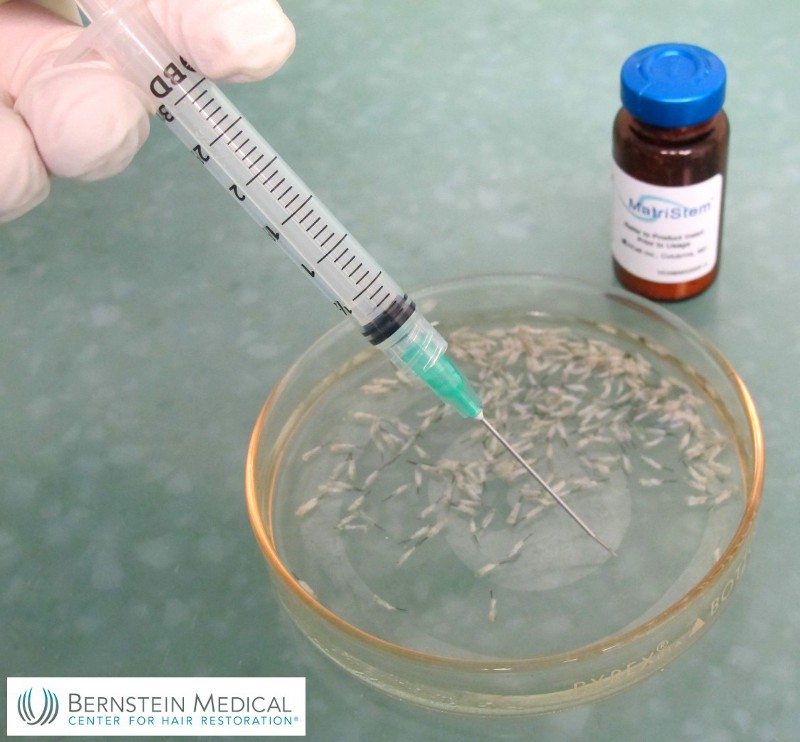
In a modification of this procedure, the bulbs of the hair are separated from the shafts and then cultivated in vitro (outside the body). After the cells are multiplied, they are injected into the pores of local, dormant hair follicles in the balding area. The problem with either technique is that matrix keratinocytes (the plucked cells) are only transient amplifiers, and the stem cells around the bulge region of the follicle, the ones most important for hair growth, are not harvested in any significant numbers and can’t be readily activated to produce a hair.

The Model for Hair Cloning

When it comes to cloning, hair follicles are in a tough spot. They are too complex to be simply cultured (growing hair follicles in a test tube would be like trying to grow a set of teeth) and follicles are not whole organisms (like Dolly) and, therefore, cannot be outright cloned. Fortunately, a pair of clever scientists, Drs. Amanda Reynolds and Colin Jahoda (now working with Dr. Christiano), seem to have made great headway in solving the dilemma.

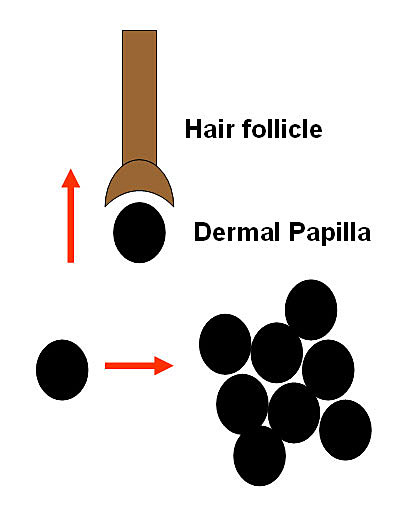
In their paper Trans-Gender Induction of Hair Follicles, the researchers have shown that dermal sheath cells, found in the lower part of the human follicle, can be isolated from one person and then injected into the skin of another to promote the formation of new intact hair. The implanted cells interacted locally to stimulate the creation of full terminal (i.e. normal) hair follicles. Although this is not actually cloning (see the definition above), the dermal sheath cells can potentially be multiplied in a Petri dish and then injected in great numbers to produce a full head of hair. The word potentially is highlighted, as this multiplication has not yet been accomplished. It seems, however, that this hair “induction” processes is the model most likely to work.

Another interesting aspect of their experiment is that the donor cells came from a male but the recipient, who actually grew the hair, was a female. The importance of this is that donor cells can be transferred from one person to another without being rejected. Since repeat implantations did not provoke the typical rejection responses, even though the donor was of the opposite sex and had a significantly different genetic profile, this indicates that the dermal sheath cells have a special immune status and that the lower hair follicle is one of the bodies "immune privileged" sites.

In addition, there is some evidence that the recipient skin can influence the look of the hair. Thus, the final appearance of the patient may more closely resemble the bald person’s original hair, than the hair of the person donating the inducer cells. The person-to-person transfer of cells would be important in situations where there was a total absence of hair. Fortunately, in androgenetic alopecia (genetic hair loss) there is a supply of hair on the back and sides of the scalp that would serve as the source of dermal sheath cells, so the transfer between people would rarely be necessary.

Probably the most important aspect of this experiment is the fact that these “inducer” dermal sheath cells are fibroblasts. Fibroblasts, as it turns out, are among the easiest of all cells to culture, so that the donor area could potentially serve as an unlimited supply of hair.

What Still Needs to be Done

At the 2003 meeting of the ISHRS, Dr. Jerry Cooley succinctly pointed out the problems that still confront us in cloning hair (or what he more accurately terms Follicle Cell Implantation). First, there is the need to determine the most appropriate follicular components to use (dermal sheath cells, the ones used in the Collin/Jahoda experiment, are hard to isolate and may not actually produce the best hair). Next, these extracted cells must be successfully cultured outside the body. Third, a cell matrix might be needed to keep them properly aligned while they are growing. Finally, the cells must be successfully injected into the recipient scalp in a way that they will consistently induce hair to grow.

Unlike, Follicular Unit Transplantation (FUT), in which an intact follicular units are planted into the scalp in the exact direction the surgeon wants the hair to grow, with cell implantation there is no guarantee that the induced hair will grow in the right direction or have the color, hair thickness or texture to look natural. To circumvent this problem, one might use the induced hair in the central part of the scalp for volume and then use traditional FUT for refinement and to create a natural appearance. However, it is not even certain that the induced follicles will actually grow long enough to produce cosmetically significant hair. And once that hair is shed in the normal hair cycle, there are no assurances that it will grow and cycle again. (Normal hair grows in cycles that last 2-6 years. The hair is then shed and the follicle lies dormant for about three months before it produces a new hair and starts the cycle over again.)

A major technical problem to cloning hair is that cells in culture begin to de-differentiate as they multiply and revert to acting like fibroblasts again, rather than hair. Finding the proper environment in which the cells can grow, so that they will be maintained in a differentiated (hair-like) state, is a major challenge to the researchers and appears to be the single greatest obstacle to this form of therapy coming to fruition. This is not unlike the problems in cloning entire organisms where the environment that the embryonic cells grow in is the key to their proper differentiation and survival.

Finally, although remote, there may be safety concerns that cells that induce hair may also induce tumors, or exhibit malignant growth themselves. Once these obstacles have been overcome, there are still the requirements of FDA approval which further guarantees safety as well as effectiveness. This is a process that involves three, very formalized stages of clinical testing and generally takes years.

On the status of cloning – it is still a work in progress. Although there has been much recent success, and we finally have a working model for how hair cloning might eventually be accomplished, much work still needs to be done.

110 East 55th Street, 11th Fl., New York, NY 10022    212-826-2400
Toll Free: 1-866-576-2400  contact@bernsteinmedical.com