Posts Tagged: Female Hair Loss

What Type of Hair Loss in Women is Suitable for Hair Transplant?

August 10th, 2009

Q: What type of female hair loss is suitable for a hair transplant?

A: A smaller percent of women with genetic hair loss are good candidates for a hair transplant as compared to men. The reason is that hair loss in women tends to be diffuse (i.e. there is thinning all over). In this situation, there is no stable donor area to use for the hair restoration.

Women with hair loss localized to the front and/or top of their scalp and good hair on the back and sides, can be excellent candidates for hair restoration, but it is important for the doctor to determine this by measuring the hair density in the donor area. This can be performed in the office using an instrument called a video-densitometer.

Conditions other than genetic thinning can be treated with hair transplantation, such as traction alopeica and hair loss from surgical scars, but some conditions, such as alopecia areata, do not respond well. It is important to have a dermatologist make sure that the condition is treatable by surgery before considering a hair transplant.

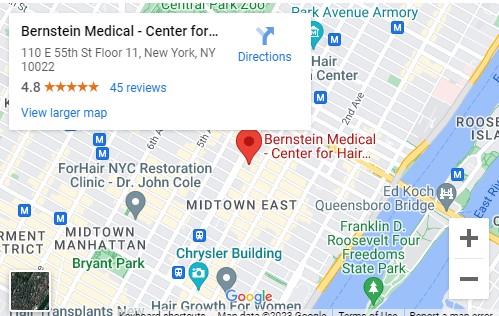
Reminder: Bernstein Medical – Center for Hair Restoration will be holding a Women’s Hair Loss Open House at our facility in Midtown Manhattan, New York City on Wednesday, August 12th, 2009 (4-6pm). You can register to attend the open house by following this link. We look forward to seeing you there!


Posted by Robert M. Bernstein M.D. at 9:38 am

What are Most Common Causes of Hair Loss in Women?

February 24th, 2009

Q: What are the most common causes of hair loss in women other than genes?

A: For localized hair loss the most common causes are traction (due to tight braiding) and alopecia areata (an autoimmune disease that produces smooth round patches of hair loss).

Other than genetic (hereditary) thinning; generalized hair loss is most commonly caused by medications, anemia, and thyroid disease.


Posted by Robert M. Bernstein M.D. at 8:21 am

Hair Loss in Women: Is Female Pattern Hair Loss Common?

February 22nd, 2009

Q: How common is female pattern hair loss?

A: It is very common. It affects about 40% of women.


Posted by Robert M. Bernstein M.D. at 4:48 am

Can Hair Loss be Caused by Pregnancy, Prozac, or Hyperactive Thyroid?

December 1st, 2006

Q: I had a baby 12 weeks ago and have recently been diagnosed with a hyperactive thyroid, although only slightly. I was also taking Prozac for 7-10 days. I am 27 and have been experiencing a significant amount of hair loss from all over my scalp. What are the chances that this would be permanent?

A: Based upon your history, you have three possible reasons for having a type of hair loss called telogen effluvium; thyroid disease, medication induced (Prozac) and pregnancy.

Telogen effluvium is diagnosed by a hair pull test and observing club hairs under the microscope. It is generally a reversible condition, regardless of the cause. Telogen effluvium most often occurs 2-3 months after the inducing event, so your pregnancy is the most likely cause.

Prozac would less likely be the problem since you have only been on it for a short time. Besides causing Telogen effluvium, thyroid disease can also alter your hair characteristics, which can make your hair appear thinner.

Other causes of hair loss, such as genetic female pattern hair alopecia, must be ruled out.

Please see Hair Loss in Women page on the Bernstein Medical – Center for Hair Restoration website for more information.


Posted by Robert M. Bernstein M.D. at 8:02 am

What are Styling Tips for Thinning Hair?

November 20th, 2006

Q: I am a 45 year old women and I am beginning to thin on the top of my scalp. I don’t want to use medications and I don’t think that I am quite ready for surgery. Is there anything else I can do?

A: There are a number of things that you can do that can make you hair look more full and help disguise the thinning. Lightening ones hair will allow the hair to reflect more light and appear thicker. In lighter-skinned races it will have the additional advantage of decreasing the contrast between the hair and skin and thus the skin will essentially act as a filler between the strands of hair.

Streaking the hair is also helpful to make the hair look thicker. Waving or perming will help as well, as it will give the appearance of more volume. Normally, the hair tends to fall into a natural part where it is the thinnest. If you part your hair in the thickest area (usually the side opposite from where you are used to, or slightly lower on the same side) this will make the hair appear fuller and less see-through.

Finally, there are a number of cosmetic products that can make you look like you have more hair.

Visit the Cosmetics for Hair Loss page on the Bernstein Medical – Center for Hair Restoration website.


Posted by Robert M. Bernstein M.D. at 8:31 am


Pages: 1 2 Next»


© 2009 Bernstein Medical, P.C. All Rights Reserved.